
Before I begin, I should qualify my remarks. Although I was born to a full-blooded Cowichan, Coast Salish mother, I am a child of the Sixties Scoop. At six months old I was taken from her, placed into a non-Cowichan home where I was raised.
I was an intense, nervous kid who devoured books the second I learned to read. English has always been my first love, my constant companion, my refuge. Books kept the crushing loneliness at bay and gave me the only real sense of belonging I ever found.
Because of that loneliness I started hunting for my biological family in my mid-teens. My Cowichan mother, who was a residential-school survivor, had already taken her own life, so there would be no tearful reunion. I did find her father, my Grampa Doug. He took on the monumental job of bringing me home to the Cowichan people, but he did it the right way. First he had to prepare me culturally. As an avid reader I had developed a ridiculous vocabulary and I used it like a club.
Grampa sat me down and warned me: many in our community had the love of learning literally beaten out of them in residential school. If I rolled up talking with big, fancy words, they would assume I was showing off, trying to make them feel stupid and small, and myself better or more intelligent.
I took that lesson to heart. For more than thirty years I have spoken plain, simple English in Cowichan territory. I learned to use an economy of words, only dropping an unwieldy one when it was absolutely necessary. That single piece of advice has made me a sharper writer, a clearer thinker, and a far better communicator.
Almost immediately after coming home I became obsessed with learning my cradle tongue, Hul’q’umi’num’. I dreamed of sitting with the elders and speaking our language fluently. I hung around the last fluent speakers, created a community currency called "Tetla" to fund seventeen language classes, and spent eighteen intense months studying with both the Hul’qumi’num’ Language Academy and Simon Fraser University.
Then reality hit like a freight train. I was born with severe deafness in my left ear. During my studies I discovered I was also going deaf in my "good" ear. No matter how many times I replayed the recordings, the subtle sounds slipped away. Even in English I can no longer tell if someone is saying "Kyla" or "Kira." Lip-reading helps, but not enough. That dream died hard.
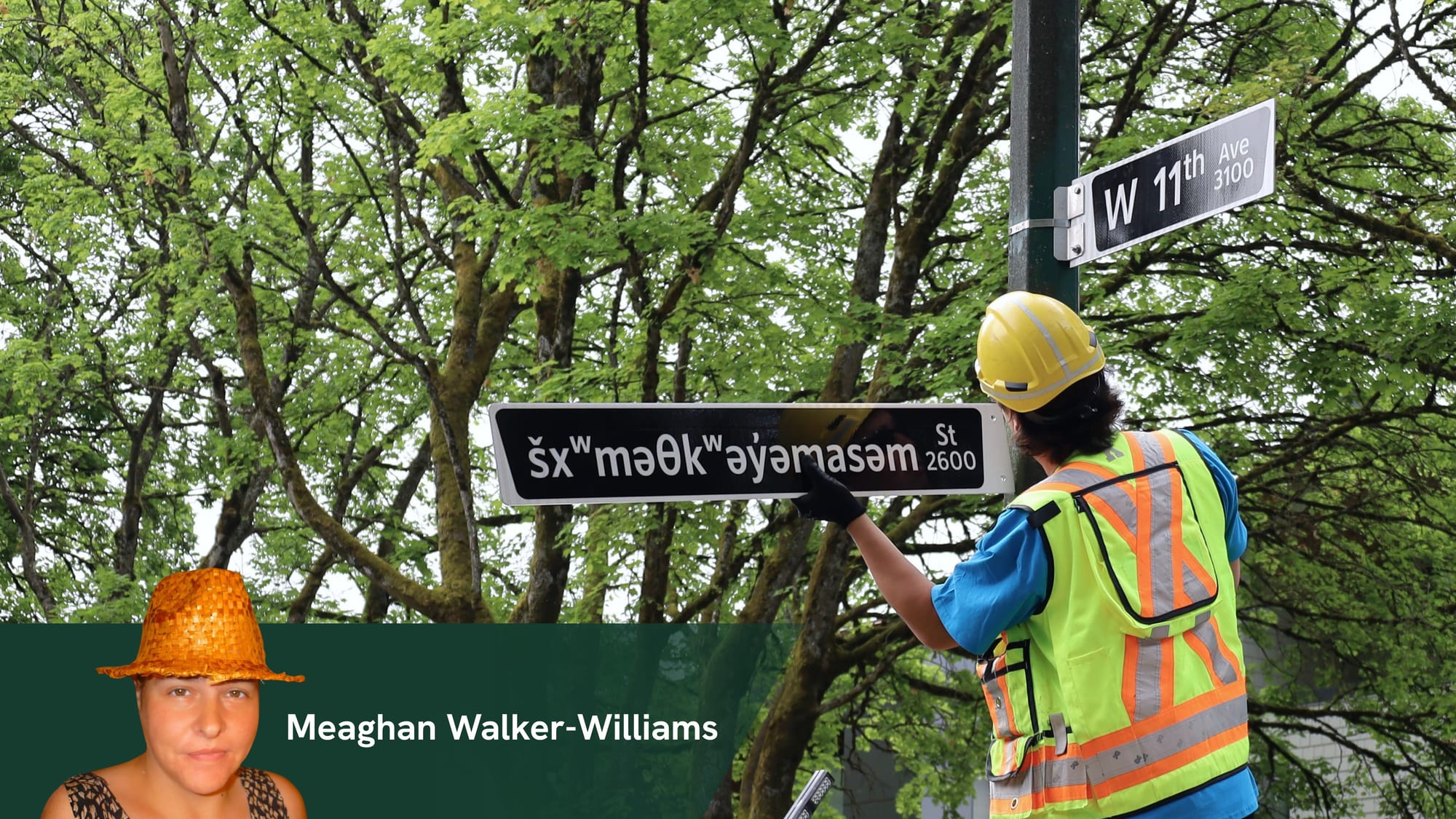
Given everything I have poured into language revitalization. and my lifelong, almost religious love of both English and Hul’q’umi’num’, you would think I’d be doing cartwheels over the current stampede to rename bridges, roads, parks, and landmarks in First Nations dialects.
I am not. In fact, I am furious.
We have a saying in Hul’q’umi’num’: “Xaa Xaa Scqwall”—“Our language is sacred.” That was the core teaching of my late mentor and friend, the respected Big House speaker Willie Seymour.
Our Language, he insisted, must be treated with reverence and never weaponized to humiliate or embarrass. Grampa Doug told me the exact same thing about my educated English: never go out of your way to make someone else feel stupid or lesser. I still live by both men’s words.
So when I see these new signs sprouting up with complicated, contradictory at times, tongue-twisting orthographies — when I watch ordinary people squint, sigh, and seethe with baffled resentment — I don’t feel pride. I feel sick.
The small clique of activists and politicians ramming these changes through seem blissfully unaware that they are achieving the precise opposite of what they claim to want. They are not reviving anything. They are poisoning the well.
Language — any language — is a human technology. Its entire purpose is to make connection easier, not harder; to help us understand one another, not to trip each other up. That is exactly why there is such fierce, widespread pushback.
The academic language police have forgotten their actual job: to help people fall in love with a language, not to bully them into resenting it.
One of the other things that finally killed my own linguistic studies was the creeping “decolonization” cult. It stopped being about learning Hul’q’umi’num’ and started being about demonizing English. Books, literature, punctuation, grammar, even clear writing itself were suddenly branded tools of oppression. Simply speaking proper English became an act of "violence."
While governments shovel tens of millions into Indigenous language nests — $15 million a year alone to the First Peoples’ Cultural Council, plus fresh federal top-ups in 2026 — there is a dark flip-side. Reviving one tongue now requires crushing another.
The irony is grotesque. We are “saving” endangered languages by turning everyday speech into a battlefield — one revival bankrolled by tax dollars, the other silenced by law. Free speech is alive and well, comrades, as long as it’s the approved variety.
I don’t know about you, but I can see exactly where this road ends. My once-pure love of languages has been permanently poisoned by the cynical notion that language should be a club to beat the “unwashed masses” over the head — again.
That is not reconciliation. That is not what any snu’wuy’ul’ (teachings) from my elders ever looked like. That is hostility, bitterness, and raw resentment wearing a sacred mask. And I will not stand for it. Not quietly. Not politely. Not without one hell of a fight.
Meaghan Walker-Williams is a Coast Salish writer, poet, mother, and cedar weaver based in Victoria.