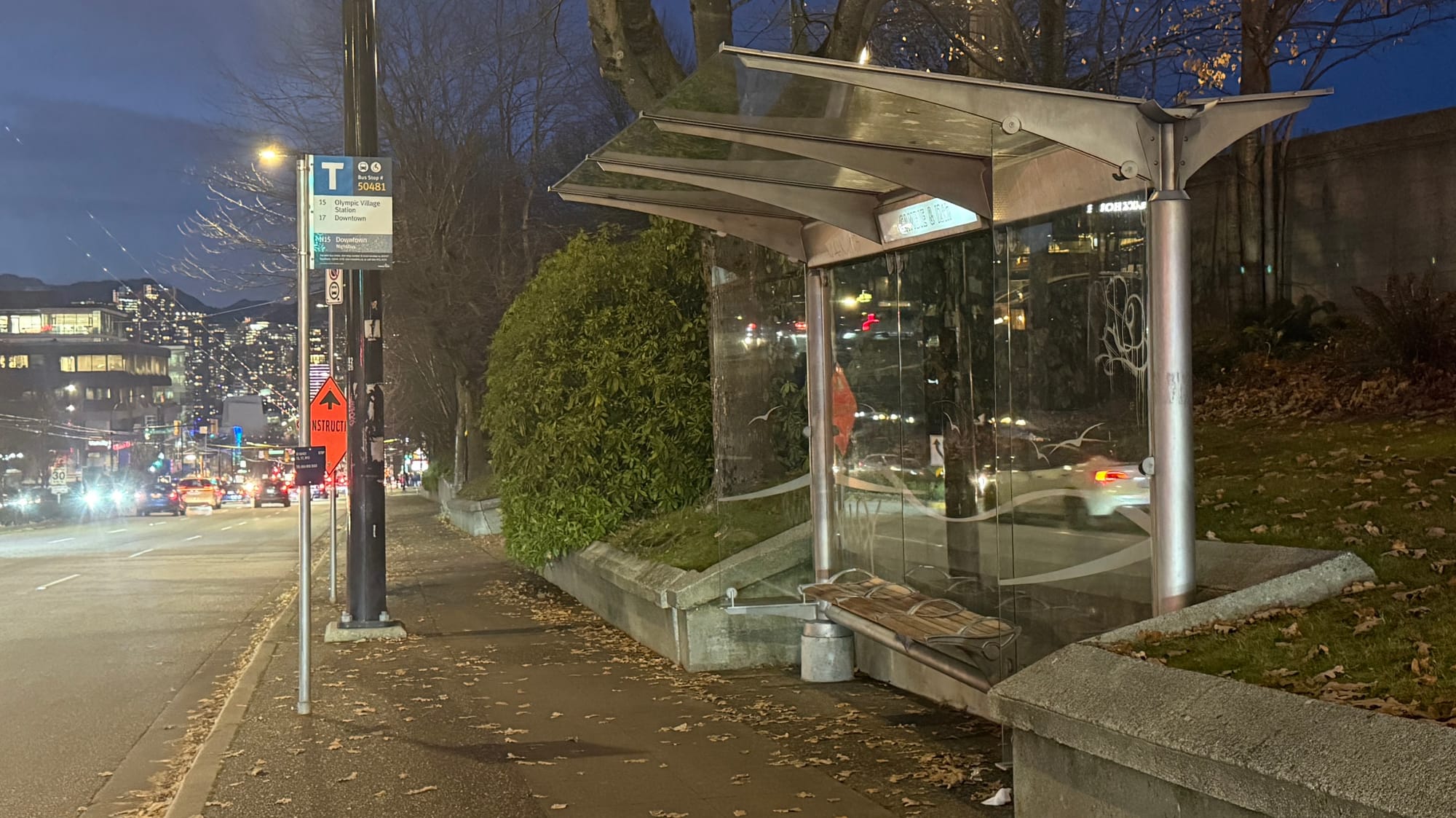


It rains in Vancouver — a lot. But only around half of the city's 1,800 bus stops have covered benches.
On Wednesday, council approved a motion introduced by Councillor Sean Orr and drafted by Councillor Solomon Yi-Kieran that brings the city one step closer to ensuring passengers stay dry while waiting for their ride.
Councillor @seanorr introduces a motion to ensure all bus stops in Vancouver have a covered bench:
— Sitka Media (@sitkamedia) November 18, 2026
"It rains in Vancouver for over half the year ... It's a real shame that every single bus stop isn't covered." pic.twitter.com/6GcARmdv1c
The "Rainy Day Fund" directs staff to deliver a report by April 2027 outlining options to build a covered bench at "every feasible bus stop" in Vancouver, with a goal of completing construction by December 2029.
Bus stops with ridership of more than 50 weekday boardings would be prioritized, with funding for work on the 100 "highest-utilized and most-appropriate unsheltered" bus stops included in the 2027 budget to facilitate construction by September of that year.
An amendment added a provision to "identify existing funding, potential contributions from TransLink and other partners, any unfunded balance, and which approved 2027-2030 Capital Plan projects would need to be deferred or reduced under each option that relies on reallocating existing capital funding."
Staff noted that in some cases, external factors such as low-hanging trees or narrow sidewalks may make constructing a shelter difficult.
Orr pointed out that while Vancouver's bus stops are built and operated via a public-private partnership, other cities such as Burnaby own and maintain their shelters and receive revenue via advertising.
The motion requires staff to include "timelines and methods to fund the project, including changes to bus shelter design, examining changes to our current public-private partnership model, and revenue from advertising" in the aforementioned report.
Among those who spoke in favour of the motion was Nav Sharma, lead organizer of the SkyTrain Riders Union.
"It's a very simple request from the perspective of a transit rider," he said. "It's something that, in the grand scheme of things, is very low-cost."
Sharma said he and his organization "would like to see less dependence on the private sector," citing the case study in Burnaby.
Vancouver city council unanimously passed a motion to work towards equipping all bus stops in the city with a covered bench.
— Sitka Media (@sitkamedia) November 19, 2026
Sitka Media’s @JarrydJaeger caught up with Councillor Solomon Yi-Kieran to learn more about what this means for public transit users. pic.twitter.com/AYkWutTMCP
Following the passing of the motion, Yi-Kieran told Sitka Media it "shows how big of a priority transit riders are."
“It's something that's going to have lots of positive benefits for transit riders," they said. "Council sees how much we need to make sure transit riders are actually getting the proper investment to be able to ride in dignity.”