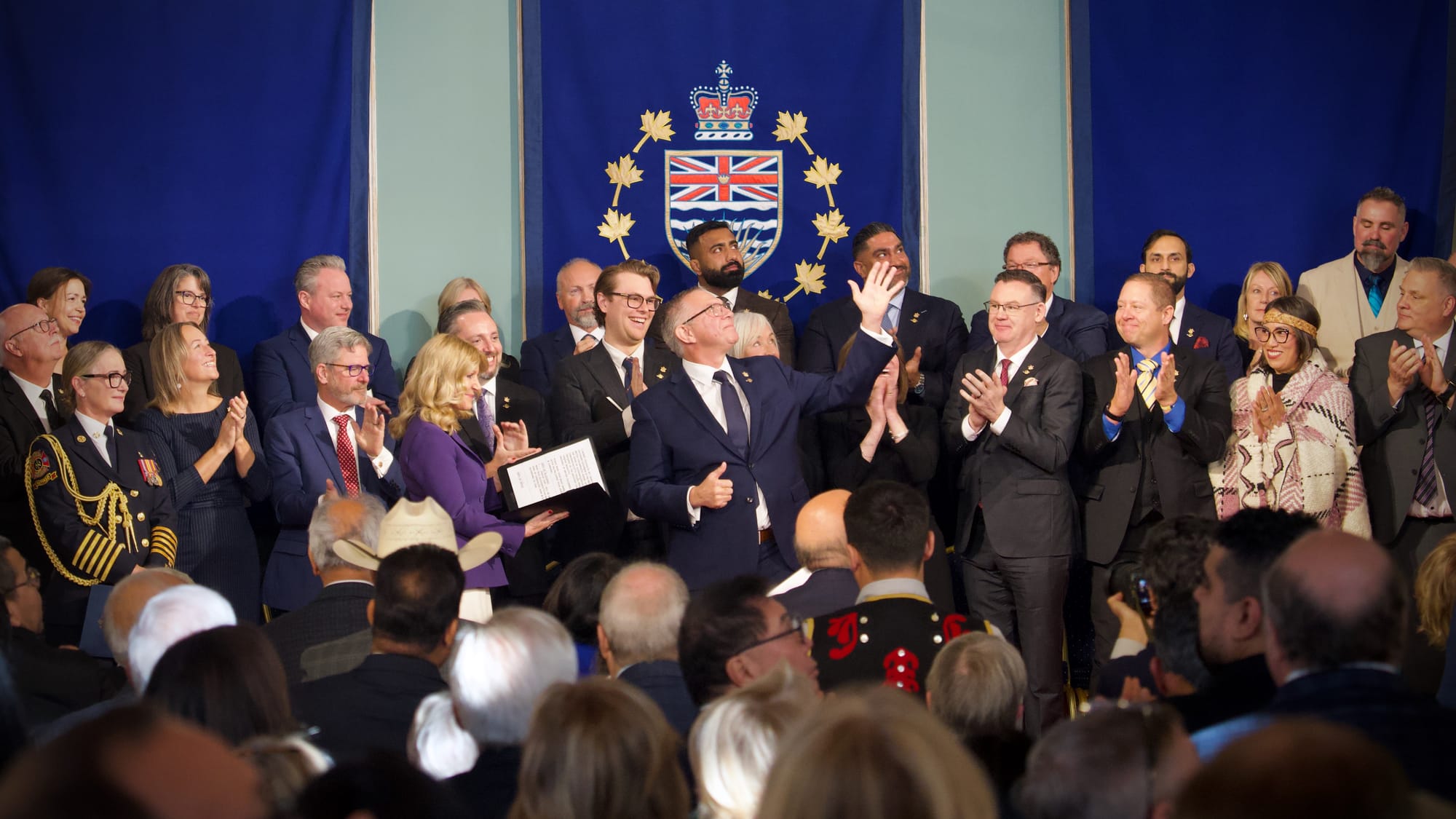


Premier Lorne Doerkson has vowed to get to work implementing his government's agenda as quickly as possible — but what exactly will that look like?
On Tuesday, cabinet ministers' mandate letters were made public, revealing exactly what the new administration plans on doing over the next four years.
According to the documents, Doerkson's demands of his new executive council centre around five key priorities: an "affordable" BC, a "prosperous" BC, a "healthy" BC, a "safer" BC, and a "strong and proud" BC.
The lengthy to-do lists detail an ambitious plan to overhaul much of the previous government's policies and take the province in a new direction.
Doerkson noted numerous times on the campaign trail that the province's purse is in rough shape. To address that, Finance Minister Peter Milobar has been asked to "immediately appoint an independent panel to review the Province's true fiscal position and report its findings publicly," and "chart a realistic return to fiscal balance over time, with spending benchmarks and guardrails as the economy grows."
Milobar has also been tasked with following through on Doerkson's promise to "keep auto insurance affordable by maintaining ICBC as a public option and preserving no-fault for the vast majority of claims, while giving catastrophically injured victims access to legal representation, with capped legal fees so lawyers’ costs do not drive up premiums or reduce what accident victims receive."
Now-former premier David Eby accused Doerkson of wanting to introduce private options to BC's public healthcare system. Health Minister Ryan Peterson has been asked to "implement the Universal Health-Care Guarantee, providing publicly funded treatment through another qualified provider when medically recommended wait times are exceeded," as well as focus on keeping rural emergency rooms open, and ensuring healthcare worker shortages are addressed.
His ministry will also work with others to "end the 'safe supply' approach to drug use; expand drug courts; move funding to prevention, treatment and recovery; stop forcing drug-friendly facilities on communities; and review and reform overdose prevention sites and injection sites."
Doerkson has stated numerous times that repealing the Declaration on the Rights of Indigenous Peoples Act is one of his top priorities. The mandate letters for Attorney General Caroline Elliott and Indigenous Relations and Reconciliation Minister Scott Mclnnis show he meant it.
They have been tasked with "repeal[ing] DRIPA and section 8.1 of the Interpretation Act, with a transition framework respecting constitutional obligations to First Nations," as well as "the NDP’s Crown litigation directives on Aboriginal title and property rights."
Elliott and McInnis have also been asked to "develop an Aboriginal Title Transparency Act ... to publish information about claims, negotiations, legal actions and agreements affecting public or private land before they become binding," and "support introduction of the Property Rights Defence Act, to uphold the validity of the Land Title Act on all fee-simple properties in BC."
Repealing Sexual Orientation and Gender Identity 1-2-3 was also one of Doerkson's top priorities. Education Minister Lynne Block has been asked to do just that, as well as "address bullying directly, protecting students from harassment based on personal characteristics, while strengthening parental transparency, choice and student safety."
Block's list of deliverables also includes "restor[ing] letter grades for Grades 4–9 and supervised provincial examinations," and "prioritiz[ing] evidence-based literacy, mathematics and foundational learning."
In addition, she has been tasked with ensuring the "daily singing of O Canada" returns to classrooms, and that schools display both the Canadian and BC flags.
On the environmental front, Minister A’a:líya Warbus has been asked to "introduce legislation to repeal CleanBC and associated regulatory requirements to remove barriers to responsible resource development," "review and reform the output-based pricing system to improve industrial competitiveness and environmental outcomes," "establish one set of outcome-based environmental rules, scaled to a project’s footprint," and "set fixed timelines for each stage of an assessment that meet or beat other leading jurisdictions and publish progress against them every quarter."
Many BC Conservative candidates and supporters took umbrage with the fact that certain public green spaces across the province, such as Joffre Lakes Park, have been closed to the general public at certain times for various reasons.
To reverse that trend, Warbus has been asked to "restore public access to Crown land, beaches and the backcountry for all British Columbians through legislation, subject only to legitimate conservation and safety requirements."
In order to create a more prosperous province, there need to be ways for people and goods to get from Point A to Point BC more efficiently and affordably. The government's top priority on this file is the Massey Tunnel replacement project, which is in the process of being reviewed to see if a bridge is a better option.
Transportation Minister Trevor Halford has also been asked to "support the expansion of transit where population and ridership demonstrate the need, and the cost of expansion is financially sustainable for taxpayers," with a focus on the Surrey-Newton SkyTrain.
Additionally, Halford will seek to "amend the South Coast British Columbia Transportation Authority Act so TransLink cannot put a tax or levy on owning or registering a car," and "commission an independent review of TransLink’s capital costs, executive compensation, administrative and operating costs, and TransLink’s own revenue sources before considering any new or additional funding requests."
Many British Columbians rely on ferries, however the federal government's recent budget dedicated far more funding to the east coast than the west coast. Halford has been tasked with helping to "renegotiate federal ferry funding to levels comparable to Atlantic ferry services."
To ensure ferries are built in BC, he will also "review current fleet renewal contracts and launch a BC Ferries Fleet Renewal Strategy" to prioritize local production.
Citizens’ Services Minister Bruce Banman has been asked to, among other things, “restore a public directory of government officials” — something many British Colombians have asked for.
You can read the individual minister's mandate letters below:
• Attorney General Caroline Elliott: CLICK HERE
• Agriculture Minister Ian Paton: CLICK HERE
• Children and Family Development Minister Kristina Loewen: CLICK HERE
• Minister of Citizens’ Services and Technology Bruce Banman: CLICK HERE
• Minister of Economic Development and Tourism Gavin Dew: CLICK HERE
• Minister of State for Red Tape Reduction Carson Binda: CLICK HERE
• Minister of State for Rural Development Anna Kindy: CLICK HERE
• Minister of Education and Child Care Lynne Block: CLICK HERE
• Minister of Energy, Mines and Petroleum Resources Larry Neufeld: CLICK HERE
• Minister of State for Mining Pete Davis: CLICK HERE
• Minister of Environment A’a:líya Warbus: CLICK HERE
• Minister of Finance Peter Milobar: CLICK HERE
• Minister of Forests Kiel Giddens: CLICK HERE
• Minister of Health Ryan Peterson: CLICK HERE
• Minister of Indigenous Relations and Reconciliation Scott Mclnnis: CLICK HERE
• Minister of Local Government, Housing, Sport and Culture Cathie Ounsted: CLICK HERE
• Minister of State for Housing Zeeshan Wahla: CLICK HERE
• Minister of Post-Secondary Education and Labour Korky Neufeld: CLICK HERE
• Minister of State for Labour Harman Bhangu: CLICK HERE
• Minister of Public Safety and Solicitor General Jessy Sahota: CLICK HERE
• Minister of State for Emergency Management Ward Stamer: CLICK HERE
• Minister of Social Development and Deputy Premier Claire Rattée: CLICK HERE
• Minister of Transportation and Infrastructure Trevor Halford: CLICK HERE
• Minister of Water, Land and Natural Resource Operations Donegal Wilson: CLICK HERE