


Oil and gas workers and the thousands of people who work alongside them have much to celebrate this Labour Day.
The value of what thousands of women and men have done to move Canada closer to becoming an energy superpower can now be measured.
They persevered through years of controversy and opposition to major energy projects, pipelines most of all. Today, we can look back at what they actually built — and what that work has delivered for British Columbia and Canada.
Philip Cross recently prepared a deep dive for Resource Works examining three major projects: the Trans Mountain Expansion Project, Coastal GasLink and LNG Canada.
The economic benefits are no longer theoretical. They can now be measured, and they are substantial.
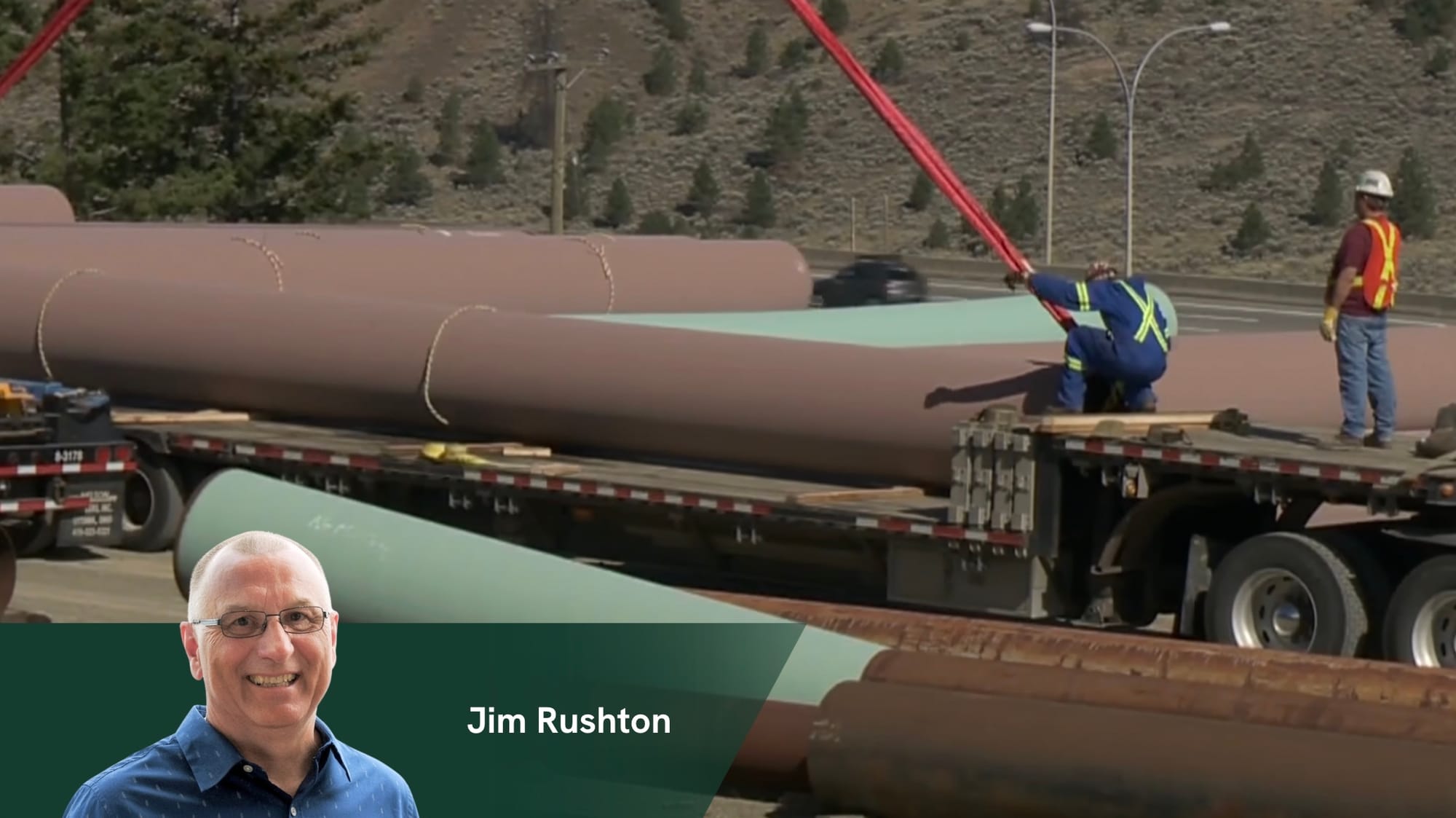
Workers manufactured the parts and equipment, transported them across the province, cleared rights-of-way, welded pipe, poured concrete, operated heavy equipment and built the pipelines and LNG Canada terminal. Much of that work has been taken for granted.
This Labour Day, Cross’s report helps shine a light on what those workers, from the shop floor to the building trades, delivered for the benefit of everyone.
From a working-class perspective, several numbers stand out:
- Real combined oil and gas output rose by 92.2% between 2015 and 2025.
- Employment in the oil and gas industry more than tripled, from 3,604 workers in 2001 to 11,328 in April 2026.
- Average weekly pay reached $2,755.11, the highest of any industry in British Columbia and more than double the provincial average of $1,356.36.
For workers and their families, those numbers mean more jobs, more opportunities and some of the highest paycheques available anywhere in the province.
Their impact reaches well beyond employment and wages.
LNG Canada and Coastal GasLink are now part of a broader wave of new infrastructure taking shape across northern British Columbia.
Combined with the opening of CANXPORT at the Port of Prince Rupert and the planned North Coast Transmission Line, these investments are helping rebuild industrial capacity along the Highway 16 corridor.
For communities that saw much of their older industrial base disappear, there is once again reason to believe that modern manufacturing and resource-processing industries including mass timber, refining and other forms of value-added production can emerge and expand.
Major infrastructure creates the foundation on which other industries can grow. The pipelines and LNG Canada have also helped establish a new benchmark for Economic Reconciliation.
Over the years of construction, relationships between Indigenous workers, communities, major project developers and the building trades have evolved considerably.
Benefit agreements, procurement opportunities, community supports, infrastructure investments, education and training programs, and health supports have all become increasingly important parts of major project development.
That progress has helped build toward one of the most significant First Nations equity positions in British Columbia’s history: the Haisla Nation’s majority ownership of Cedar LNG, the world’s first Indigenous majority-owned LNG project.
That does not mean disagreements over development, title, governance or consent have disappeared.
Today, progress on reconciliation is again facing significant strain. Hopefully, studies such as Philip Cross’s can help lower the temperature and encourage pragmatic, respectful approaches to the present-day friction.
The economic relationships built through these projects provide an important foundation for that work.
The scale of Indigenous participation in these projects deserves particular attention.
- The Trans Mountain Expansion delivered more than $5.7 billion in contracts to Indigenous businesses, while Indigenous workers accounted for roughly 11% of its 30,000-plus cumulative hires.
- Coastal GasLink directed more than $1.5 billion to Indigenous and local contracts, while Indigenous workers completed more than one-third of the work on the project.
- LNG Canada spent more than $4.9 billion locally and with First Nations, while thousands of workers participated in construction of a project whose peak workforce exceeded 8,000 people.
These are not simply project statistics. They represent wages, businesses, skills, careers and economic opportunities distributed across communities throughout British Columbia.
Perhaps one of the most important legacies of these projects is psychological. Their completion has restored confidence that British Columbia can build big.
Two major pipelines have been completed. LNG Canada is operating. The Westridge Marine Terminal has undergone a major expansion. Workers, contractors, Indigenous businesses, governments and regulators have accumulated years of experience in constructing and operating major energy infrastructure while meeting environmental requirements and working with affected First Nations.
That experience should increase confidence in moving forward with the next generation of major Canadian projects. Among them is the possibility of another West Coast oil pipeline from Alberta and a new oil terminal on the British Columbia coast. The case for greater export capacity is straightforward.
Canada possesses enormous energy resources. Asia represents a growing global market. And Canada remains heavily dependent on a single customer: the United States. That makes diversification increasingly important. Recent developments in the United States reinforce that urgency.
The United States has entered into a deal to acquire a majority stake in an oil-and-gas venture in Venezuela involving access to 17 strategic oil fields containing roughly 65 billion barrels of oil.
This comes on top of the substantial volumes of Venezuelan crude already entering the United States.
According to Forbes senior contributor David Blackmon, significant new production could still take seven to ten years to bring online.
He also argues that part of the strategic logic is about “reducing reliance on an increasingly China-aligned Canada.”
Whether or not one accepts that characterization, the broader lesson for Canada should be obvious. The United States is looking for ways to diversify its energy supplies. Canada should also diversify its customers. The early results from our newest export infrastructure demonstrate why.
The off-take from both TMX and LNG Canada continues to grow, with TMX operating near capacity. Over recent months, interest in Canadian oil has continued to be expressed throughout Asia.
That is precisely what access to the Pacific was intended to accomplish: give Canadian producers alternatives and give Canadian workers access to the economic activity generated by serving global markets.
As the numbers in the Resource Works report show, the expansion of mining, oil and natural gas has helped Canada withstand the economic pressures created by the first year of US tariffs.
In British Columbia specifically, oil and gas accounts for 61.9% of the $9.7 billion in capital spending across the province’s mining sector in 2026.
That investment translates into work.
It means more opportunities for tradespeople, equipment operators, manufacturers, contractors, engineers, Indigenous businesses and communities.
It means more workers earning the average $2,755.11 weekly paycheque available in British Columbia’s oil and gas industry. And it means more royalties, taxes and government revenues generated by the economic activity those workers make possible. British Columbia’s working class will be strengthened by more of this work.
The people who built TMX, Coastal GasLink and LNG Canada have already demonstrated that British Columbia can still build major projects.
The challenge now is to give the next generation of workers something big to build. Canada has its economic future to fight for.
Jim Rushton is a 46-year veteran of BC’s resource and transportation sectors, with experience in union representation, economic development, and terminal management.