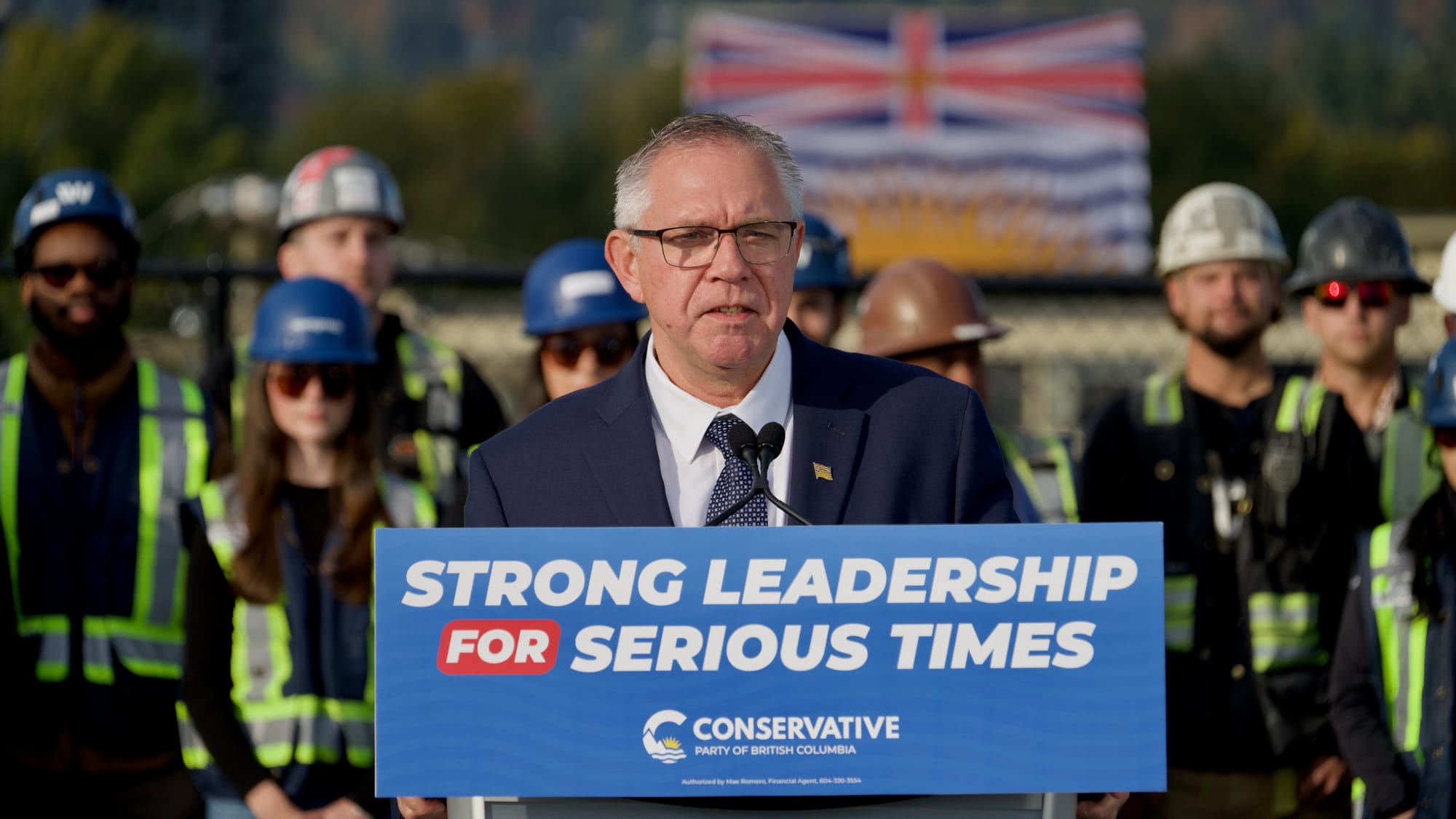




There’s been plenty of popcorn-worthy drama surrounding the BC Conservative Party over the past two weeks, but beyond the high-profile MLA departures, ideological purity tests, and controversial firings, we are witnessing a fundamental shift in British Columbia’s political landscape.
The BC Conservatives are facing a question about what kind of party they want to be — and their answer will shape our provincial politics for years to come.
When the dust has settled and our popcorn bowls are empty, I suspect the remaining caucus will be more united than ever, but the party will be significantly harder to elect.
The exits of five MLAs from the BC Conservatives over the past two weeks have dominated the news, but their departures are symptoms of the problem. What we’re seeing inside their caucus is a reemergence of many of the divisions that helped break apart the BC Liberal/BC United “Free Enterprise Coalition” which, for decades, asked Red Tories, Blue Liberals, true-blue-conservatives, and pragmatic centrists to accept compromises and nuanced positions in the interest of defeating the BC NDP and governing from the centre-right.
Such compromises always caused friction, but those divisions were not insurmountable. In this day and age, however, social-media algorithms reward conflict and ideological purity, driving toxic partisan engagement while the loudest voices online are routinely mistaken for public opinion. Today, nuance looks like weakness, and compromise is cast as betrayal.
Under these conditions, holding a broad political coalition together can feel Sisyphean.
It shouldn’t then surprise you to learn that the exits of MLAs Peter Milobar, Ian Paton, Rosalyn Bird, Teresa Wat, and Brennan Day are openly being celebrated by factions on the right. A quick scan through #bcpoli Twitter reveals a significant amount of glee over their departures.
Taken together, the internal purity tests and sweeping turnover of caucus and party staffers, followed by the new leadership’s apparent willingness to let MLAs walk, suggest a deliberate choice to prioritize ideological homogeneity over building a broader, big-tent voter coalition.
Why? For starters, a smaller and more ideologically aligned caucus is easier to manage, and their priorities are easier to message. Less time spent putting out internal fires and negotiating positions with MLAs on a litany of issues means more time to focus on the external battle with the BC NDP and to offer supporters a sharper partisan identity.
Unshackled by internal friction and the constant need to compromise, this new iteration of the BC Conservatives may well find itself doing better with certain segments of voters, swallowing up the further-right OneBC Party, and reducing that pressure on their right flank.
But there’s a cost to choosing the comfortable tent over the crowded one.
Our first-past-the-post electoral system rewards broad coalitions and punishes fragmentation. A party can dominate the political conversation online and still fall short in the vital seats needed to form government. To defeat the BC NDP, the BC Conservatives need more than an energized conservative base; they must also persuade the more centrist voters who helped deliver 16 years of power to the BC Liberals.
By instead choosing the quick path to internal unity, the BC Conservatives will likely become easier to lead while simultaneously obscuring their path to forming government. The party may emerge from this drama more united than ever and more coherent in their purpose and their messaging, but the centre-right overall will have fractured and their left flank will be vulnerable.
Whether that new opening is ultimately filled by the new party Milobar and Paton are building, former cabinet minister Mike Bernier’s CentreBC, or whatever plan emerged from Wednesday evening’s “Triple O Summit” of frustrated business leaders and centre-right political operatives in Vancouver, remains to be seen.
Any viable new option for voters will require party organization, plenty of donors and volunteers, and a nuanced political message capable of appealing across old partisan lines. In other words, it will have to construct the exact kind of coalition, and accept the exact kind of compromises, that the BC Conservatives are now shunning. After all, the gulf between the political beliefs of Rosalyn Bird and Brennan Day, who both jumped ship from the Conservatives this week, is not exactly small.
But Mark Carney’s strong national approval ratings suggest there may still be an appetite for a coalition of Red Tories and Blue Liberals and also that clickbait, polarization, and TikTok-sized attention spans may not have quite killed the potential for coalition-building. That heavy boulder still exists, it has simply rolled to a new and untrodden path.
Whoever next tries to rally British Columbia’s centre-right, by committing to the hard work of bringing people together and the never-ending task of keeping them united in an increasingly divisive world, has a real opportunity in the next election should they get organized. However, only time will tell whether that leader can do better than Sisyphus.
Andrew Reeve is a Senior Public Affairs Consultant at Earnscliffe. He previously served as Press Secretary and Deputy Director of Communications for the Official Opposition under the BC Liberals and BC United. The views expressed are his own.