


Vancouver is a city plagued by the most exquisite of afflictions: it is far too beautiful for its own good. It’s blessed with water so pure and ice-cold you can drink it straight from the tap without first offering a small prayer of gratitude and populated by citizens who greet you with impeccably calibrated plastic smiles as you pass on the street.
These smiles, of course, mean nothing — and nor would yours — yet they offer the rare civic luxury of non-invasive human contact that will not derail your day or demand anything so vulgar as actual connection.
Should you prefer your pleasures gastronomic in nature by feeding yourself through the hands of others, there are a multitude of cultures represented within the city allowing your palate to explore in perpetuity without risking a bore. Uncontroversially, it goes without saying, Vancouver is home to the best sushi anyone could enjoy outside of Japan. That is a fact.
Day-to-day life in the city for your average joe can be brilliant — expensive, yes — but it truly is a wonderful place to be, under the strict assumption you are not a local sports fan.
For those uninitiated, the City of Vancouver has been tormented by unimaginable, repeatable bouts of heartache for those who cheer balls kissing nets, or who watch squat black cylinders glide across ice in search of twine.
The city’s longest-running instructor in this particular misery has been its NHL franchise, the Vancouver Canucks. Born in 1970, the team has spent more than five decades perfecting the art of exquisite, slow-burning torment through a special blend of mismanagement: years of questionable trades, even more questionable drafting decisions, a revolving-door of coaching staff, and ownership decisions that seemed custom-engineered to keep hope flickering just brightly enough to make the inevitable collapse feel personal.
Three times the city dared to believe. Three times it has been rewarded with exceptional cruelty; the Stanley Cup Final in 1982, the miracle run of 1994 that ended in a Game 7 heart-stopper in New York followed by riots in the streets, and the even more crushing 2011 edition, when a 3-2 series lead evaporated in Game 7 on home ice and the city rioted again.
In the end, the Canucks have never brought Lord Stanley’s cup back to the famed Stanley Park. Not once. And no, the Vancouver Millionaire’s 1915 win of the Stanley Cup does not count. The Canucks remain the most beloved losing team in British Columbia sports history, a perpetual near-miss machine that keeps promising paradise and delivering only the echo of what might have been.
You may be curious to know how the Canucks are doing these days. I could belabour you with information regarding the current status of the team, but I hold restraint in not subjecting you to such tortures.
The NBA, arriving fashionably late to the party in the mid-90’s, proved it could match the Canucks blow for blow. Vancouver became home to the newest member of the league, the Vancouver Grizzlies. The excitement was palpable. People were abuzz over having Vancouver finally represented in the NBA.
However, it was a colossal flop — the team won just 101 games while losing 359 over six miserable seasons, never once sniffing the playoffs, and setting records for futility and consecutive losses along the way.
They were impressively bad: in their first season dancing on the hardwood of then GM Place, they went 15-67 after starting 2-0. They never won more than 23 games in any season in Vancouver and they set an NBA record at the time with 23 consecutive losses. Not long after their final season, the management group decided to provide the city with more torment as they announced the team’s sale to a Chicago businessman, Michael Haisley, who, despite promises to keep the franchise in Vancouver, wasted little time finding a new home for it in Memphis.
Lest anyone imagine the pattern had finally been cracked, Vancouver’s newest professional franchise — the women’s hockey team, the Goldeneyes — arrived in 2025 with the same bright flicker of hope. Their home opener flooded the Pacific Coliseum (original home of the Vancouver Canucks), in a way that suggested this time the city might be spared its familiar fate. Yet here they sit, second-last in the PWHL, already sliding back into the well-worn groove of early promise followed by quiet disappointment.
Another chapter in this city’s long record of near-misses, further proof that, in Vancouver, sporting greatness remains a solitary miracle — that miracle however, would currently wear the colour blue.
Almost against the city’s better judgment, something briefly worked — and in the most unexpected place. The Vancouver Whitecaps arrived in 1974 as part of the old North American Soccer League, a modest outfit playing out of Empire Stadium.
For five years they were pleasant enough. Then came 1979. Against all odds, the “deserted village” of Vancouver — famously labeled by ABC’s Jim McKay, who joked that the city must be empty with every eye in town glued to their living room screens — upset the star-studded New York Cosmos and defeated the Tampa Bay Rowdies 2-1, to win the Soccer Bowl.
It marked the first major North American professional championship ever claimed by a Vancouver team. The city lost its mind. The next day, hundreds swarmed the Vancouver International Airport to greet the team as they landed and as many as 100,000 people lined the streets of downtown Vancouver for a championship parade that still ranks as one of the largest public celebrations in British Columbia history.
That single afternoon of pure, unfiltered joy did something remarkable: it planted the seed for a new downtown stadium. The civic momentum from that victory helped accelerate the construction of BC Place, which opened in 1983 and became the architectural catalyst that reshaped modern downtown Vancouver into the gleaming waterfront city we know today.
And then, for decades, the Whitecaps slipped back into polite afterthought status — until, quite suddenly, they didn’t. The quiet revolution began in late 2019 when current CEO Axel Schuster arrived as sporting director, laying the patient groundwork for a more professional, ambitious club culture.
That foundation was later brought to life on the pitch when Vanni Sartini, who had joined as an assistant in 2019, took the reins as head coach in 2021. Sartini injected personality, tactical fearlessness, and a genuine belief that the Whitecaps could be more than just respectable — he helped shape the modern identity and winning mentality that still lingers.
He taught Vancouver that they were allowed to be good again. Under him and head coach Jesper Sørensen, the club has now transformed from perennial also-ran into something dangerously close to a success story. In 2025, their first full season under the new regime, the Whitecaps shattered club records for wins, points, and goals scored. They reached the final of the Concacaf Champions Cup, claimed their fourth straight Canadian Championship, won the Western Conference, and made their first-ever appearance in the MLS Cup final.
They signed global talent like Thomas Müller and played with a modern, tactically crisp identity that felt light-years removed from the club’s previous eras of modest competence. For the first time in memory, Vancouver soccer fans weren’t just hoping — they were expecting.
Hope, that rarest of local commodities, had finally arrived.
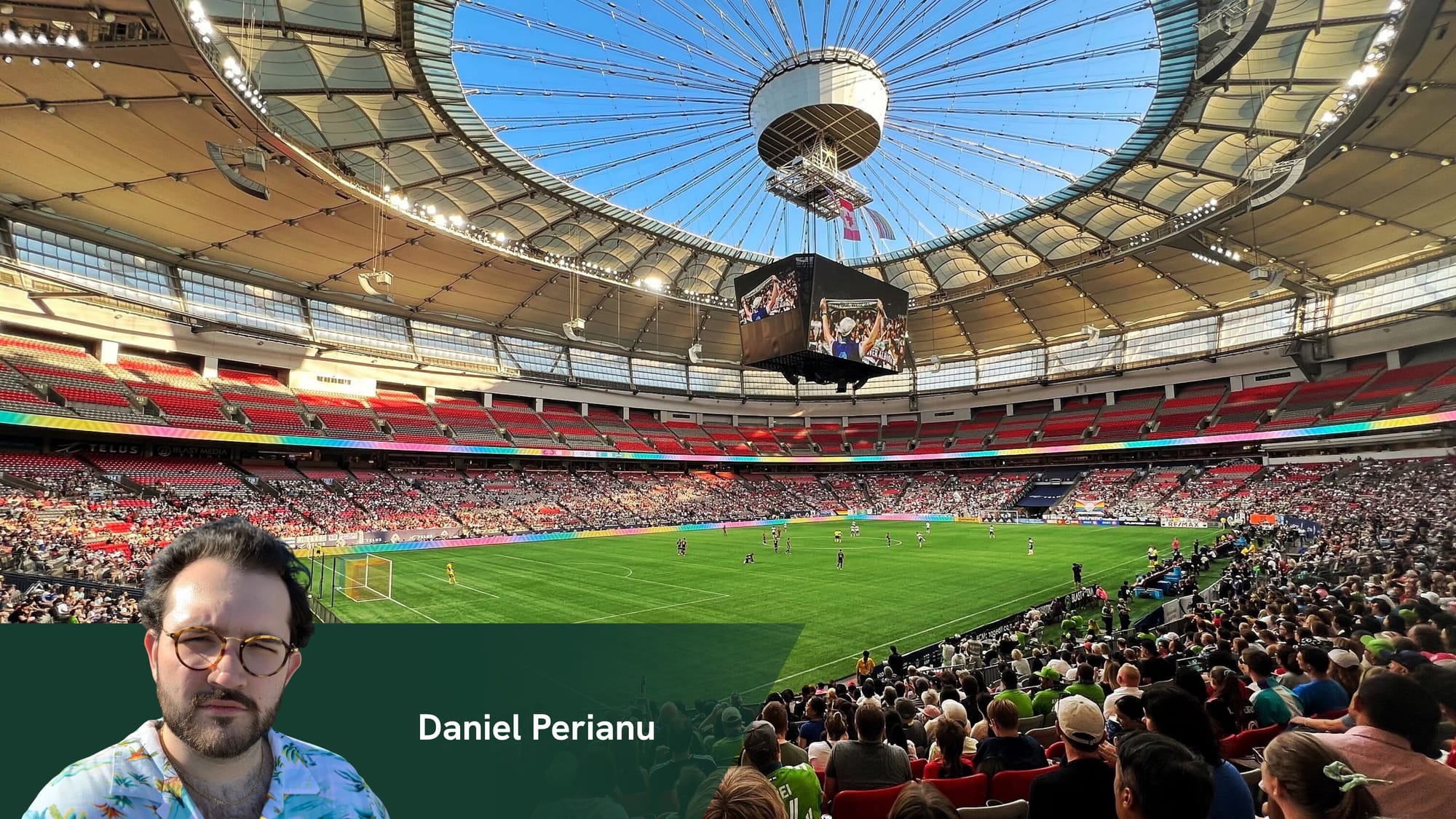
But even now, the old Vancouver curse lingers like fog off the inlet. While the team is winning on the pitch, off it the franchise sits in the same precarious limbo that once swallowed the Grizzlies. The lease at BC Place is temporary, ownership has quietly shopped the club for buyers, and MLS itself has all but warned that without a viable long-term stadium solution by the end of 2026, relocation remains a very real “Plan Z.”
Indianapolis and half a dozen other cities are already circling above BC Place’s retractable roof like rampant vultures. The parallels are impossible to ignore: a promising franchise, a city that loves it, and the creeping fear that, once again, Vancouver’s best may be packed up and shipped south. Only this time the team isn’t losing. This time they’re winning — and the city is holding its breath, wondering if the heartbreak will finally be different.
So what does it mean when, against every instinct and every precedent, something in this city finally keeps working?
The Whitecaps’ sudden competence is more than just points on a table. It is the first sustained proof in half a century that Vancouver sports fans can be rewarded rather than punished for their loyalty. It is the sound of a city exhaling after decades of holding its breath. And it carries an echo of 1979: that single Soccer Bowl victory didn’t just hand out trophies — it physically reshaped the skyline.
Could lightning strike twice?
Imagine it does. Imagine the negotiations through 2026 succeed and a new soccer-specific stadium rises at Hastings Park — on the old PNE grounds, the same patch of East Vancouver soil that once hosted midway lights, livestock barns, and the roar of a horse track now fallen silent. Picture 20,000 fans streaming in on match nights, yes — but picture more than that. Picture the entertainment district that grows around it: restaurants and public plazas, concert stages and community greens, all built on city-owned land under a long-term lease that asks nothing from the taxpayer’s pocket for the stadium itself.
For the Whitecaps and their long-suffering faithful, it would mean something deeper than silverware. It would mean permanence. No more temporary leases, no more relocation whispers, no more holding your breath every off-season. It would be the first time in the city’s modern sporting history that a franchise is allowed to put down roots and grow into something permanent, something that belongs here the way the mountains and the inlet do.
But the real transformation would ripple far beyond the supporters in blue and white. East Vancouver — that vast, historically overlooked shoulder of the city — would suddenly find itself with a new heartbeat.
The same neighbourhood that once felt like an afterthought to the glass-tower downtown would become a destination in its own right: a place where match-day crowds spill into local businesses, where concerts and festivals draw people who have never watched a corner kick in their lives, where new transit links (long promised, long delayed) finally materialise because the demand can no longer be ignored.
For the average Vancouverite — the non-sports watcher who simply wants to get across town without spending half their life on a bus — the stadium could quietly deliver the kind of practical magic the city has been craving. Better SkyTrain or bus connections to Hastings and East Van. More evening and weekend service.
A genuine reason for the province to invest in the kind of reliable, everyday infrastructure that makes daily life less of a grind. Construction jobs in the short term; hospitality, retail, and creative-economy jobs in the long term. Not the abstract promise of “economic growth,” but the tangible kind: paycheques landing in local pockets, small businesses finding new customers, young people discovering they don’t have to leave the province to find work that feels meaningful.
British Columbia, a place that has spent years quietly worrying about its economic pulse, would receive something it desperately needs: an injection of production that doesn’t rely on cutting down more trees or digging more holes in the ground. A living, breathing catalyst built on sport and spectacle and sheer stubborn optimism — the same stubborn optimism that once turned a single championship parade into BC Place and the downtown we now take for granted.
If it happens, the Whitecaps would hand Vancouver something the Canucks and Grizzlies just haven't: not just a winner, but a second act. A second chance for the city to prove that beauty, plastic-politeness and good sushi are not the only things it knows how to do well. That it can also, finally, keep something working.
The question, then, is no longer “When will they break our hearts again?” It is the one the title has been asking all along: What do you do when everything keeps working?
For now, the city is doing what it has always done best: hoping, quietly, while trying not to jinx it.