
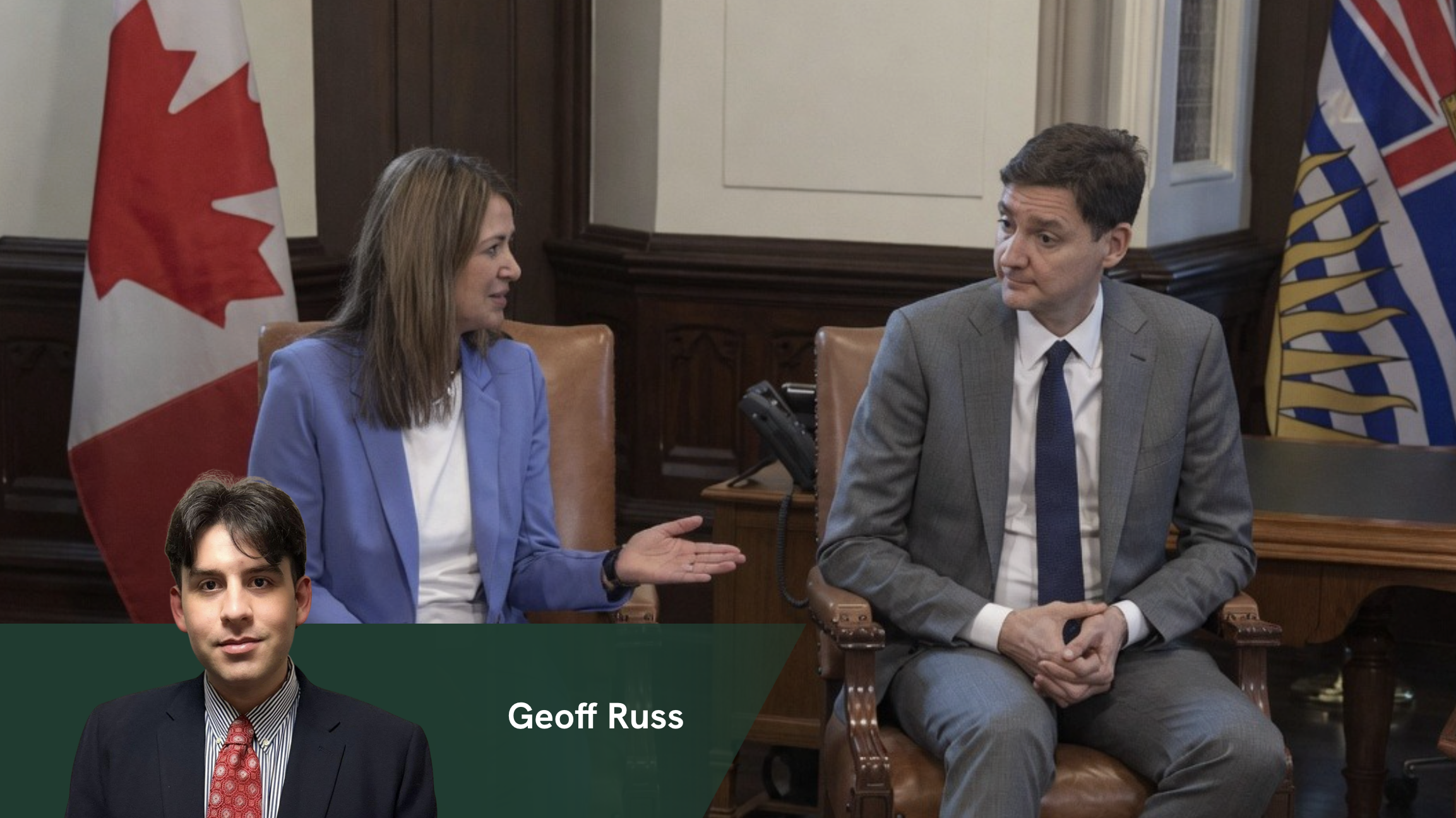

David Eby is cranking the old lever of anti-Alberta politics in a bid to save his New Democrat government.
He called Prime Minister Mark Carney’s conditional support for a new Alberta-British Columbia pipeline to the coast as giving undue attention to “separatists”, while doing everything he can to stop that pipeline.
Bashing Alberta is a familiar tactic in British Columbia. Eby’s predecessor, John Horgan, happily engaged in it, fighting the Trans Mountain pipeline expansion (TMX) every step of the way until the project was approved by the Supreme Court of Canada in 2020.
At the time, the BC Green Party was relevant and relatively powerful, considering the NDP had to rely on it for support in the legislature. The Green-NDP agreement meant that every barrel of bitumen to be carried by TMX was treated as a potential legal case or law school seminar, and as an opportunity for BC progressives to flex their opposition to the Albertan energy industry.
Horgan fought and fought from 2017 to 2020, doing his bit to cause delay after delay. Alberta was furious, even with fellow NDP premier Rachel Notley in charge of Wild Rose Country until 2019. In the end, however, TMX was still built and entered commercial service in May 2024, moving almost 900,000 barrels of oil per day.
Now, in 2026, Eby can buy a few big headlines by going after Alberta’s ambitions for another pipeline, but public opinion, Canada’s economic trends, and the power of Ottawa are all against him. It will not, however, rescue Eby’s sinking popularity in the midst of a crisis over DRIPA and Aboriginal title that has upended the province.
Repeating Horgan’s playbook made a bit more sense in 2018, from a public relations standpoint.
At the time, current Alberta premier Danielle Smith was still a radio host and political columnist. She teased Horgan for opposing TMX and then complaining about high gas prices in the Lower Mainland, which she pointed out was “ocean-and-mountain-locked” and dependent on limited routes for fuel. It was a punchy argument, and one with a basis in reality, for gas prices in the Lower Mainland actually did fall after TMX was completed in 2024.
Today, public opinion favours another energy bridge between the Albertan oil sands and the British Columbian coast. Angus Reid found last October that 56 per cent of people in BC supported a new pipeline through northern BC.
Eby is trying to rerun expired political battles with an audience that is opposed to his intransigence and exhausted by his leadership. When Eby calls for Ottawa to stop rewarding “bad behaviour”, it will not magically revive his abysmal polling numbers nor dull the knives being prepared for him by his own caucus.
Neither Alberta nor Danielle Smith is the reason why Eby is one of the most unpopular premiers in the country.
Angus Reid had Eby’s approval at 37 per cent in March, down 16 points year over year, while pointing to public worries over the over-extended budget deficit, health care access problems, and the explosive issue of Aboriginal title.
On the other hand, polling is not uniform. Leger put Eby at 43 per cent approval, and the NDP only narrowly ahead of the leaderless Conservatives, but 54 per cent of British Columbians still say the province is on the wrong track.
In addition to Aboriginal title, the controversies over the Declaration on the Rights of Indigenous Peoples Act (DRIPA) were another positive headline in 2019 under Horgan that has since become a splitting headache for Eby.
DRIPA has come to dominate politics in BC, and the NDP are constantly on the defensive. The First Nations Leadership Council (FNLC) bullied Eby into backing down on DRIPA amendments, and courts strengthened it into a potential veto on any legislation that does not align with DRIPA.
Regarding oil, Eby’s attempt to detour around the pipeline by suggesting that he build a publicly funded refinery was a major flop.
To be clear, promoting a refinery was no more than a more polite way of saying “no” to a pipeline. Those with experience in the energy industry scoffed at the suggestion. The suggestion of a refinery came in January and has been completely forgotten, all while momentum for a new pipeline continues to build.
Eby is not bereft of advantages in this pipeline battle, though he controls few of them. There is still the legal opposition that will come from Indigenous groups like the Coastal First Nations. Carney himself has conditioned any pipeline on the scaling up of carbon capture technology, and First Nations consultation still looms.
However much leverage those barriers may accord, none of it belongs to Eby or the NDP. It certainly will not alter the public image of the provincial government. Alberta’s referendum and the separatist faction there will not make the DRIPA mess go away, erase the budget deficit, or produce a family doctor for all who need one.
Eby can oppose Alberta and Ottawa — and their joint agreement — all he likes, in addition to the promise of another pipeline. But, as John Horgan learned with the Supreme Court, there is little choice in the matter for the BC provincial government. Energy spent bashing Alberta is better spent elsewhere.
If the premier backs down, perhaps they will even name the next pipeline after him.
Geoff Russ is Editor-at-Large of Without Diminishment and contributor to the National Post.