


A report recently compiled for the Canadian Urban Transit Association has found a link between investment in public transit and "long-term economic prosperity."
The Canadian Chamber of Commerce's Business Development Lab drew upon data from CUTA, Canada's major transit agencies, and Statistics Canada to analyze the far-reaching impacts of spending more on ensuring people can get from A to B without a vehicle.
According to the report, every dollar invested in transit infrastructure "generates nearly twice its value in GDP." Transit operations and capital investments across Canada contribute an estimated $65.6 billion in GDP and $40.6 billion in wages, as well as over 507,000 jobs and $5.5 billion in tax revenues.
Between 2019 and 2023, transit agencies across the country invested an average of $10.4 billion a year in capital, which supported more than 142,000 jobs, $9.9 billion in wages, and $2.6 billion in tax revenue every year. Three-quarters of that came from outside transit agencies via suppliers, contractors, and spending by workers' households.
When it comes to jobs created by capital investment, 47% were in construction, 15% were in manufacturing, and 12% were in transportation.
The authors noted that, "beyond these direct economic contributions, public transit strengthens labour mobility, helps reduce congestion, improves access to employment and supports the efficient movement of people across Canada's growing urban regions."
Population growth and affordability concerns have resulted in increased public transit use across Canada in recent years. Available funding has also increased, however not at pace with capital investment needs.
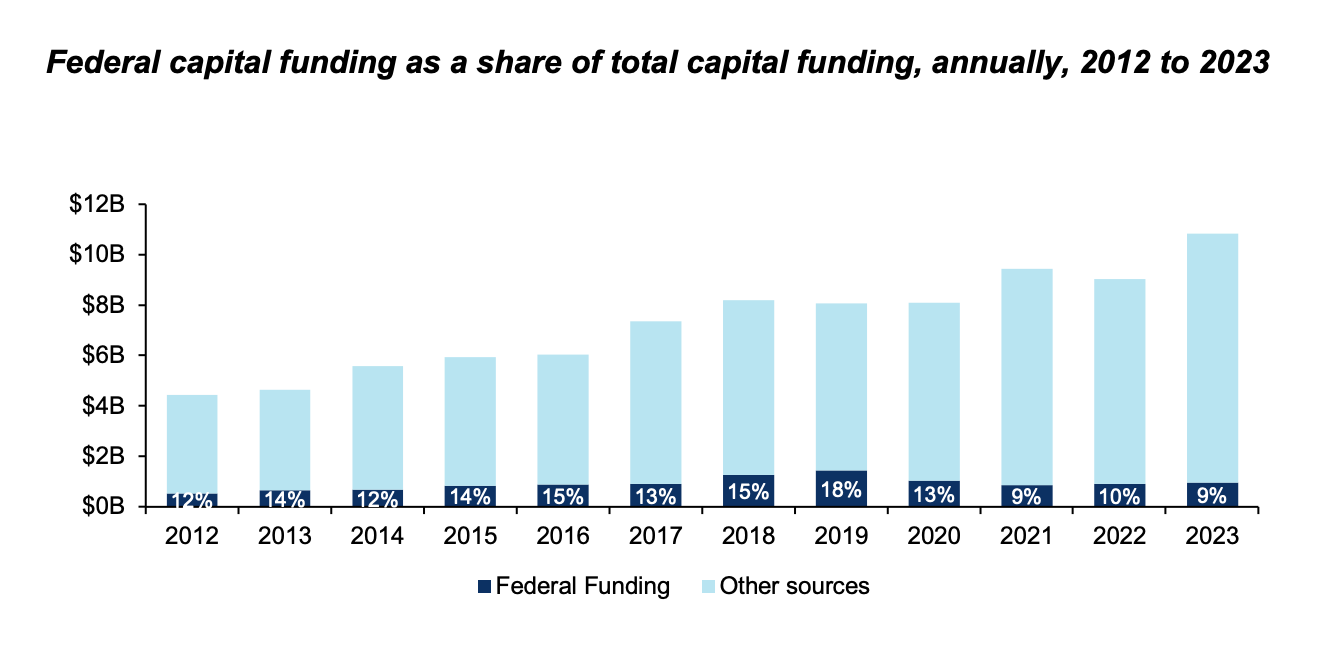
Four of the country's major transit agencies identified a combined $50 billion in unfunded capital needs over the next decade, most of which is just for maintaining existing systems — not expansion.
Accounting for nearly half of the aforementioned funding needs is Metro Vancouver's TransLink.
"Transit is essential economic infrastructure," CEO Kevin Quinn said. "It connects people to jobs, helps businesses reach the workforce they need, and keeps our region moving. Those benefits extend to everyone whether they take transit or not. Investing in reliable transit supports a stronger economy, and underinvestment carries a real cost in congestion, lost time, and missed opportunities."
A local 2024 study found that "significant service reductions would increase annual household costs by up to $1,000 and increase congestion by up to 20% across Metro Vancouver."
"As Metro Vancouver continues to grow, maintaining the transportation network people rely on today is just as important as expanding service to meet future demand," the agency added. "Long-term, sustainable investment in both is essential to keeping the region competitive, supporting businesses and connecting people to opportunity."
CUTA has made four demands for the federal government:
Provide predictable, long-term transit funding: Establish a protected multi-year funding envelope with clear annual allocations so transit agencies have certainty over the amount of funding available and can plan major fleet renewal and infrastructure investments with confidence.
Ensure committed funding is deployed without delay: Set clear timelines for funding agreements, approvals and disbursements so committed funds reach project-ready investments quickly. Faster deployment also helps protect the real value of funding from being eroded by rising construction costs.
Prioritize fleet renewal needs: Directed funding toward aging assets and critical replacement projects before deterioration leads to higher maintenance costs, service disruptions and more expensive rehabilitation later.
Strengthen funding accountability and long-term planning: Work with transit agencies to maintain a transparent pipeline of priority projects, unfunded capital needs, funding commitments and delivery milestones. This would help identify gaps earlier, improve investment certainty and ensure federal funding translates into projects on the ground.
The Canada Public Transit Fund had allocated billions of dollars over a 10-year period, however in Budget 2026, portions of transit infrastructure were folded into the Building Communities Strong Fund. It is unclear whether that move will result in less funding than was originally allocated for transit.