


Last week, Abacus Data released some dismaying polling.
As David Coletto describes, data indicate that one in three Canadians says a strong leader who does not have to bother with Parliament and elections could be a good way to govern. And among Canadians under 30, that number rises to 47 per cent. That is nearly half our young people reporting support for what amounts to authoritarianism. For under 45s, the proportion stays stubbornly high at 42 per cent.
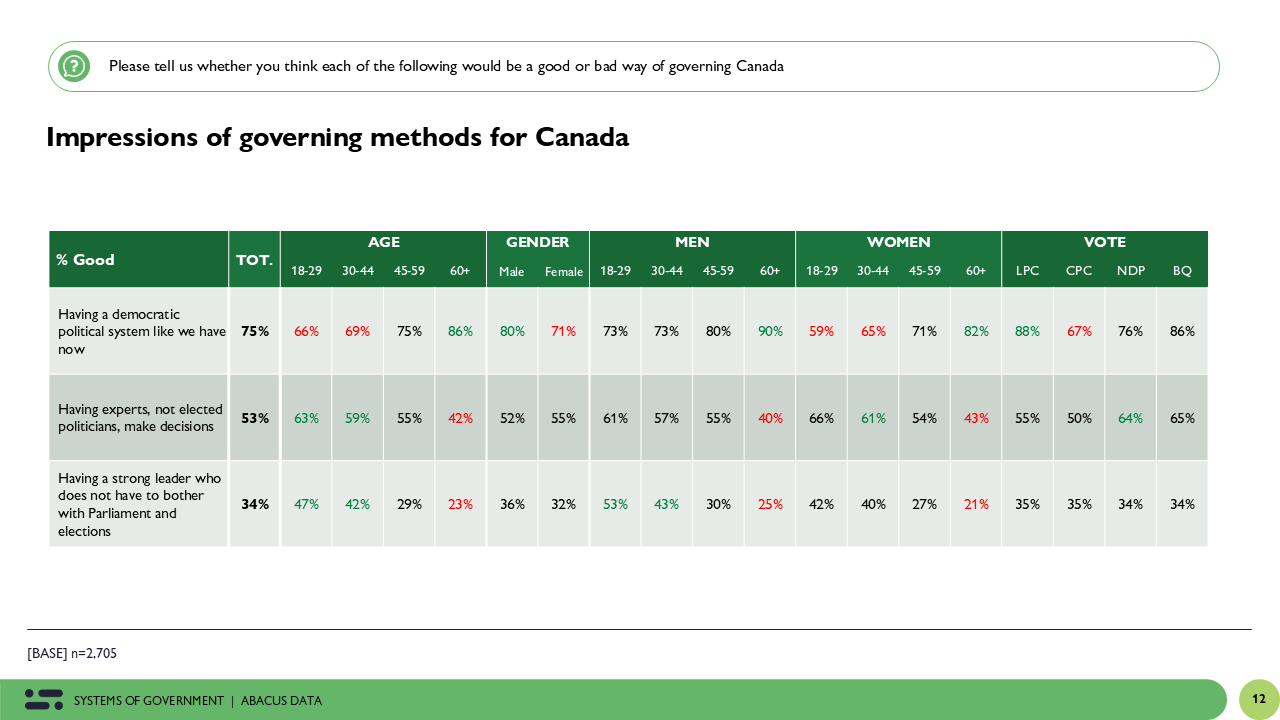
Our systems of governance are seen as so useless by every other young Canadian that they may as well be ignored entirely.
More than anything, I interpret this finding as an indictment of legislators across the country who have let the problems disproportionately plaguing younger generations fester for decades: housing, wage stagnation, poor economic opportunities, limited childcare availability, and so on.
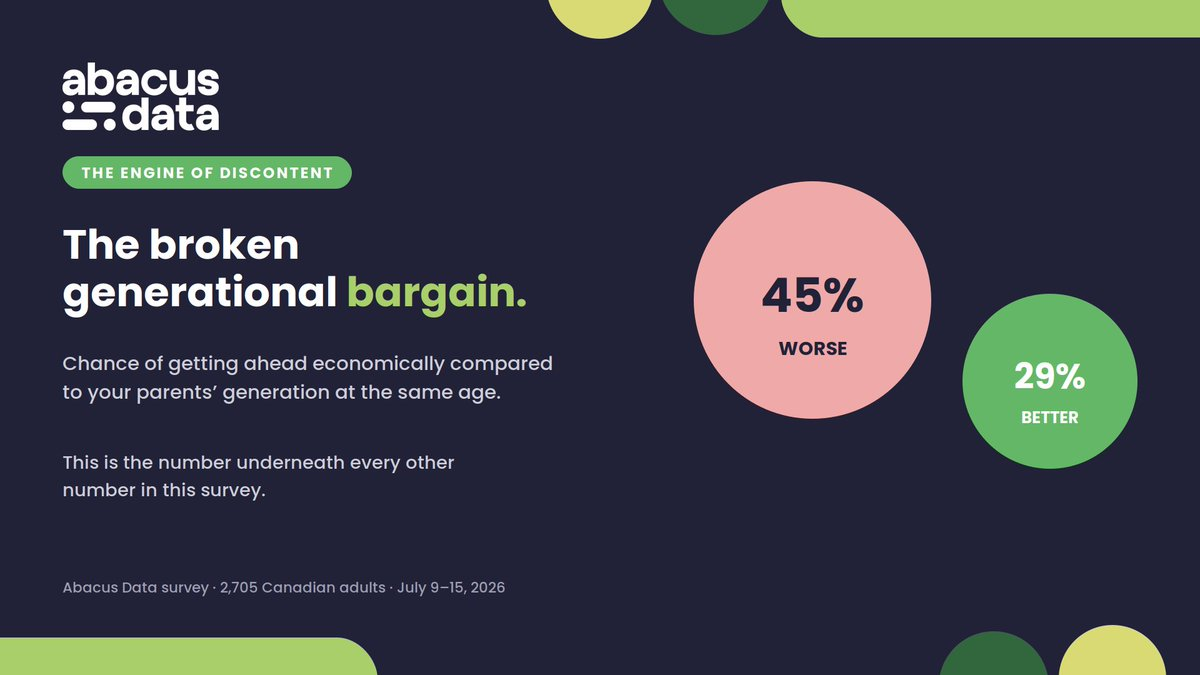
Indeed, Coletto highlights that 45 per cent of Canadians say their chances of getting ahead economically are worse compared to their parents' generation at the same age, with only 30 per cent saying they are better, identifying these numbers as underpinning every other number in the survey.
These findings ought to alarm us all, perhaps especially older Canadians. Everyone wants to give their children a shot at a good life, and a sense of hope that the future is bright. But many in younger generations seem not to hold this hope anymore.
When I am feeling sour or disheartened, I remember my grandpa's “Martinisms”.
Born during the Great Depression, Grandpa started shovelling coal into the belly of a steam engine before he finished high school. Working his way up to locomotive engineer, he spent his days winding trains through the Rocky Mountains and back for nearly half a century.
In discussing the economic conditions faced by younger generations today, Grandpa will remind me that things have been far worse. When he was growing up, it was common for men to come knocking at their front door to ask if there was any food to spare. “You always shared if you had something. You had to help each other out to survive, that’s just the way it was.”
Yet Grandpa ended up supporting three kids and a stay-at-home wife on his CN salary, building a home with a garden and pool on land that was previously an orchard outside of town. He tells me how lucky they were, because home ownership was not the norm when he grew up. Indeed, data indicate that slightly over half of Canadians owned a home when he was young, with ownership rates rising over the decades to follow.
Part of a generation that emerged from the doldrums of widespread poverty and built the foundations of the country we enjoy today, Grandpa witnessed an explosion of technology. When he grew up, houses were just getting fitted with telephones. Now, he can listen to CNN via Bluetooth in his hearing aids.
Beyond technological advancement, governments of generations past also enacted transformative change for the better. In his time, the Trans-Canada Highway was built, and programs like universal healthcare, the Canada Pension Plan, and B.C.’s Agricultural Land Reserve were delivered from zero to one.
I see no such equivalent projects or programs that have been built in recent decades.
All of this is to say that younger generations are not wrong to feel disenfranchised by a system that serves us poorly and accomplishes relatively little. But condemning the entire system as faulty, rage-quitting to sink into the virtual abyss of alternate reality and hope that a strongman comes to transform our world, precludes us from considering the best Martinism of all: “the best is yet to come” (also attributable to Frank Sinatra).
What if it really was? And what if you actually believed it?
You could imagine the untold marvels the future may hold. Imagine all the novel discoveries and getting to watch the world unfold as you grow old and to tell stories of the days when we thought the world was going to hell – how wrong we turned out to be.
But you can’t see it if your vision is clouded by defeatism.
Giving up on liberal democracy is defeatism. While the processes may seem pointless to generations for whom they have delivered little, entertaining the notion of their dismissal is no solution. Besides all the well-trod arguments about the dangers of authoritarianism, willingness to see the processes of government ceded altogether is just another way of “numbing out”. As writer Catherine Shannon so gracefully describes:
“We all know that life does not hand out bouquets. Flowers do not just appear in the world. The same is true for a life of meaning. Both are grown, over time, from the tiniest seeds. You have to cultivate meaning in your life. You need to do the hard work of tilling the soil and nurturing the seeds. No one can do it for you. Grow your own flowers and give them away to everyone you meet. You’re right: the earth is not very fertile, people are not always grateful, flowers eventually die. But do you still see the point of it all? Do you see the beauty of the gesture?”
There is beauty and meaning in the struggle and inefficiency of democratic governance. This is not to say that politics should be the vehicle through which all young Canadians restore meaning to their lives, but rather that indifference towards the processes of liberal democracy is an indicator of a broader crisis of meaning.
Younger Canadians have been left with depleted soil, but we can still grow flowers and prove that indeed, the best is yet to come.
Laurisa Dohm is a BC-based consultant and policy advisor. She holds an M.Sc from Gothenburg University.