
Kerry-Lynne Findlay promised to stop a Liberal takeover of the Conservative Party of BC.
Almost immediately after Findlay won the BC Conservative leadership race, a clandestine group convened around a corporate-coded, 19-slide prospectus to resurrect the BC Liberal’s storied political brand, as if to prove her point.
The authors of the prospectus are unknown, but identify themselves as the "Liberal Party of British Columbia," a working name that subtly differs from the official BC Liberal Party.
The prospectus begins from a reasonable premise: Recent Research Co. polling indicates that nearly half of British Columbians feel that there is room for a centre-right party to challenge both the BC NDP and the BC Conservatives.
The chatter to revive the BC Liberal Party seizes upon such data points, without acknowledging that wanting something different and being ready to vote Liberal – purely on brand alone – are two entirely distinct things.
But this “founding discussion” – as the prospectus is called – reads like a student business project masquerading as a political movement.
Strong political branding is usually built atop big ideas and vision, not the other way around.
Instead, this prospectus spends page after page selling the Liberal brand as a winner. Yet, for all its navel-gazing, any meaningful sense of a BC Liberal identity is conspicuously absent.
For the first two decades of this century, the BC Liberal Party was a political alliance between federal Liberals, federal Conservatives, suburban moderates, and business interests largely united by their opposition to the BC NDP. That coalition no longer exists.
Changing demographics, political polarization, and rising populist attitudes – whether those of former Premier John Horgan or new BC Conservative leader Kerry-Lynne Findlay – have transformed the province.
To its credit, the prospectus correctly identifies voters who feel dissatisfied with the BC NDP’s delivery of results on housing, health care, and the economy, but uncomfortable with the focus of Findlay’s BC Conservatives. This “opening” – as the prospectus puts it – and a surge of federal Liberal popularity in the province are clear.
The BC Liberal identity, however, is not.
In contrast, Vancouver’s municipal Liberals launched less than a year ago with a clear purpose: to make Vancouver easier to build in, more affordable to live in, and better governed, explicitly for younger residents increasingly priced out of the city.
Vancouver Liberal leader Kareem Allam leveraged a familiar political brand but he paired it with a steady stream of policy proposals. Whether on housing, permitting, renaming Vancouver International Airport, or supporting a Gastown soccer stadium that could keep the Vancouver Whitecaps FC in the city, that party has made a sustained effort to explain why it exists.
This prospectus for a provincial Liberal party reverses the formula, without explaining how unknown proponents calling out to unknown participants would produce a coherent identity for a coalition of voters that no longer exists.
It is not clear whether its authors envision a Liberal party meant to resemble a more competent BC NDP or a Conservative Party of BC stripped of what they describe, without any specificity, as “culture war issues”.
The prospectus reads like a start-up pitch built by people who fell in love with the company name first, while still debating what exactly the company does. It seems to assume that political identity – the core value proposition to voters – can be assembled from market opportunity, brand recognition, and boilerplate paperwork.
But even if a BC Liberal identity existed, there is no credible person to carry it.
The most obvious candidates would be a roll call of recent losers, fresh off rejection by BC Conservative members in favour of Kerry-Lynne Findlay: Caroline Elliott, Iain Black, and Peter Milobar.
Given the little daylight between those failed Conservative leadership candidates and Kerry-Lynne Findlay on major policy, such a pivot to the BC Liberals would be difficult to distinguish from naked ambition.
Other former BC Liberal/BC United MLAs who migrated to the Conservatives prior to the 2024 provincial election would face similar struggles explaining yet another partisan reinvention. At some point, it begins to look less like conviction and more like a desperate game of political musical chairs.
Former BC Greens leader Andrew Weaver, who appears to be associated with this revival effort, presents a different problem. He worked with BC NDP Premier John Horgan, but was “mostly on side” with the Conservatives ahead of the 2024 provincial election, even joining the party this year to support leadership candidate Peter Milobar.
Weaver’s apparent involvement only raises further questions about what ideological space this proposed BC Liberal revival is meant to occupy.
If the current cast of characters struggles to fit the bill, the BC Liberals’ past offers little relief.
There is little appetite to dispatch an archaeological expedition into the Gordon Campbell and Christy Clark years for the party’s old guard. Kevin Falcon’s dizzying attempt to pass off a political restoration as a renewal project ended even worse than some critics expected, with surrender and insolvency.
Port Coquitlam Mayor Brad West does not carry any such baggage or burden. But he presents a different problem.
He spent years attacking BC Liberals for their opportunistic coziness with powerful interests, particularly over the Christy Clark era. Asking him to lead that brand’s revival would require voters to forget much of what made him popular in the first place.
West illustrates one of the prospectus’ biggest blind spots: Adopting a brand means inheriting its liabilities, as well as its assets.
The prospectus acknowledges that liability, at least organizationally, when it outlines two paths forward: either wresting control of BC United from Kevin Falcon and reverting it to the Liberal namesake, or building an entirely new party while using the Liberal name as a zombie brand.
It clearly favours the latter, arguing for a debt-free balance sheet and clean governance structure, free from old baggage.
Yet, what it demands of the organization, it does not demand of the brand itself.
After all, the prospectus is branded as “The Liberal Party of British Columbia” (which does not exist, unlike the official BC Liberal Party). It is not the “Former BC Liberals Discussion Group” or the “Centre-Right Renewal Project.” It is presented as The Liberal Party of British Columbia before anything else exists to give that name meaning (or cover).
The Liberal brand carries real value. But a brand is not a party, and name recognition is not a reason to exist.
A credible Liberal revival in British Columbia requires three things this prospectus does not supply: a leader whose journey to this brand does not undermine the case for it; a specific policy agenda that conveys the party’s identity; and a convincing argument for why a "Liberal" coalition can be rebuilt in today’s political environment.
The prospectus identifies an opening, but only offers to fill that gap with something bearing the name "Liberal," as if that alone is enough.
It is not.
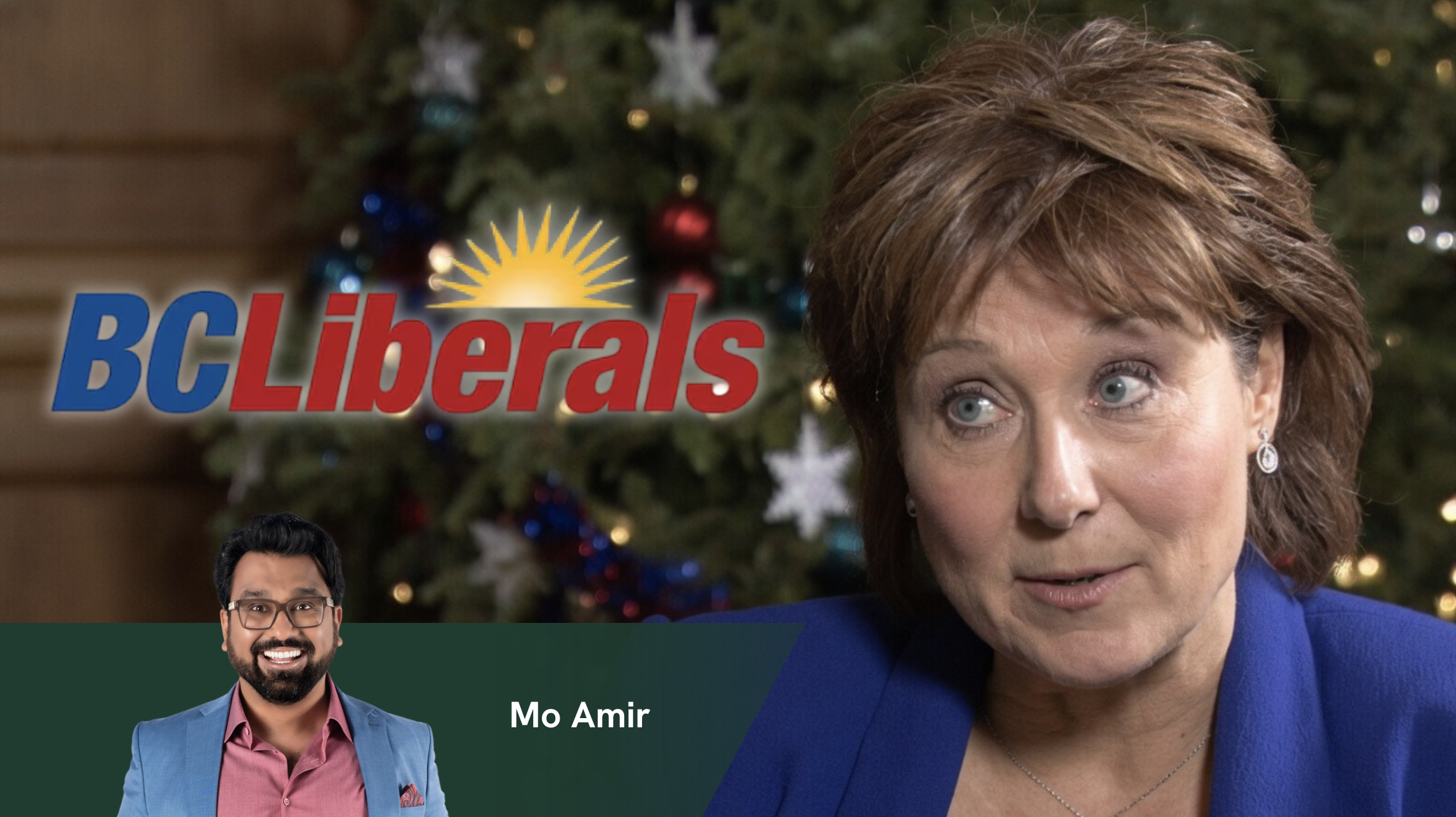
Mo Amir is the host of “This is VANCOLOUR”, British Columbia’s bonafide culture and politics TV talk show, now in its sixth season on CHEK-TV, Thursdays at 9 p.m. He is also a prolific political commentator across several outlets.