

BC Premier David Eby just called a provincial election, two years too early, for voters to say “hell no” to Donald Trump.
Trump, for his part, is not on the ballot.
The premier only decides when to call an election. He has far less control over what British Columbians decide the election is about and what message they ultimately deliver at the polls. He can, however, make his case.
Eby’s case for abruptly sending British Columbians back to the polls two years ahead of schedule – amid province-wide municipal elections, no less – is that the world has fundamentally changed since they last voted. And Donald Trump changed it.
Eby casts the US President as an existential threat to BC’s economy and Canada’s sovereignty. Trump threatens your livelihood, your family’s well-being, your very existence: “Trump is coming after us”.
This frames Premier Eby’s preferred ballot question, the defining choice he wants voters to make.
According to Eby, the province is in an "existential moment” to make a choice to build a “fire break” against Trump or be turned into “America-junior” with the importation of “MAGA-style politics” and “American-style policies”.
It is an awfully convenient choice for Eby to present to voters. It almost sounds noble: extraordinary, grave circumstances necessitating a democratic mandate from the body politic immediately.
Far less noble, of course, are the political circumstances surrounding the Premier’s decision.
For starters, Eby’s government already commands a majority in the BC Legislature. It can build the “fire break” he is now asking voters to endorse at the ballot box, unimpeded, with two full years still remaining on the mandate Eby won in 2024.
The “existential moment” has also arrived just as the political headwinds that had battered Eby for much of the past year have suddenly swung around to his back. After a prolonged stretch of sagging approval, the Premier’s numbers, alongside the BC NDP’s numbers, have rebounded just as his principal opposition, the Conservative Party of BC, has descended into spectacular dysfunction.
Kerry-Lynne Findlay just resigned as the BC Conservative leader, ending a chaotic four-month tenure and leaving the Official Opposition leaderless and severely fractured precisely at the moment Eby decided British Columbians urgently needed to vote. The Premier is not responsible for the Conservatives’ dysfunction, but choosing an electoral window so perfectly suited to exploit his opposition at its weakest makes for an almost comically fortuitous coincidence.
The Trump rationale does more than justify Eby’s snap election. It also provides the Premier and his government with a useful distraction from their own record over the past two years: a projected $13.8-billion budget deficit; the abandoned promise of a $1000 grocery rebate; recurring emergency room closures; a months-long DRIPA fiasco that frustrated Indigenous leaders and the business community alike; and an affordability crisis compounded by job losses and economic uncertainty.
Normally, incumbent governments face elections as referendums on their job performance. But Premier David Eby is trying to turn this election into a referendum on something else entirely.
The broken promises, the ‘re-pacing’ of capital projects, and the management of decline over the past two years are recast as secondary to the stakes of the next four. Aside from pulling American liquor from provincial shelves, Eby shoves his government’s record into the background.
Donald Trump takes centre stage instead.
For Eby, Trump is not just the issue, but the template through which he wants voters to see his opponents.
Neither Donald Trump nor the Republican Party appears on the ballot, but Premier Eby wants voters to view the Conservative Party of BC as an extension of the same political threat. In the “existential moment” Eby describes, the BC NDP government is the “fire break” against Trump; the BC Conservatives are the chaos that would enable Trump.
That framing has already started to buckle.
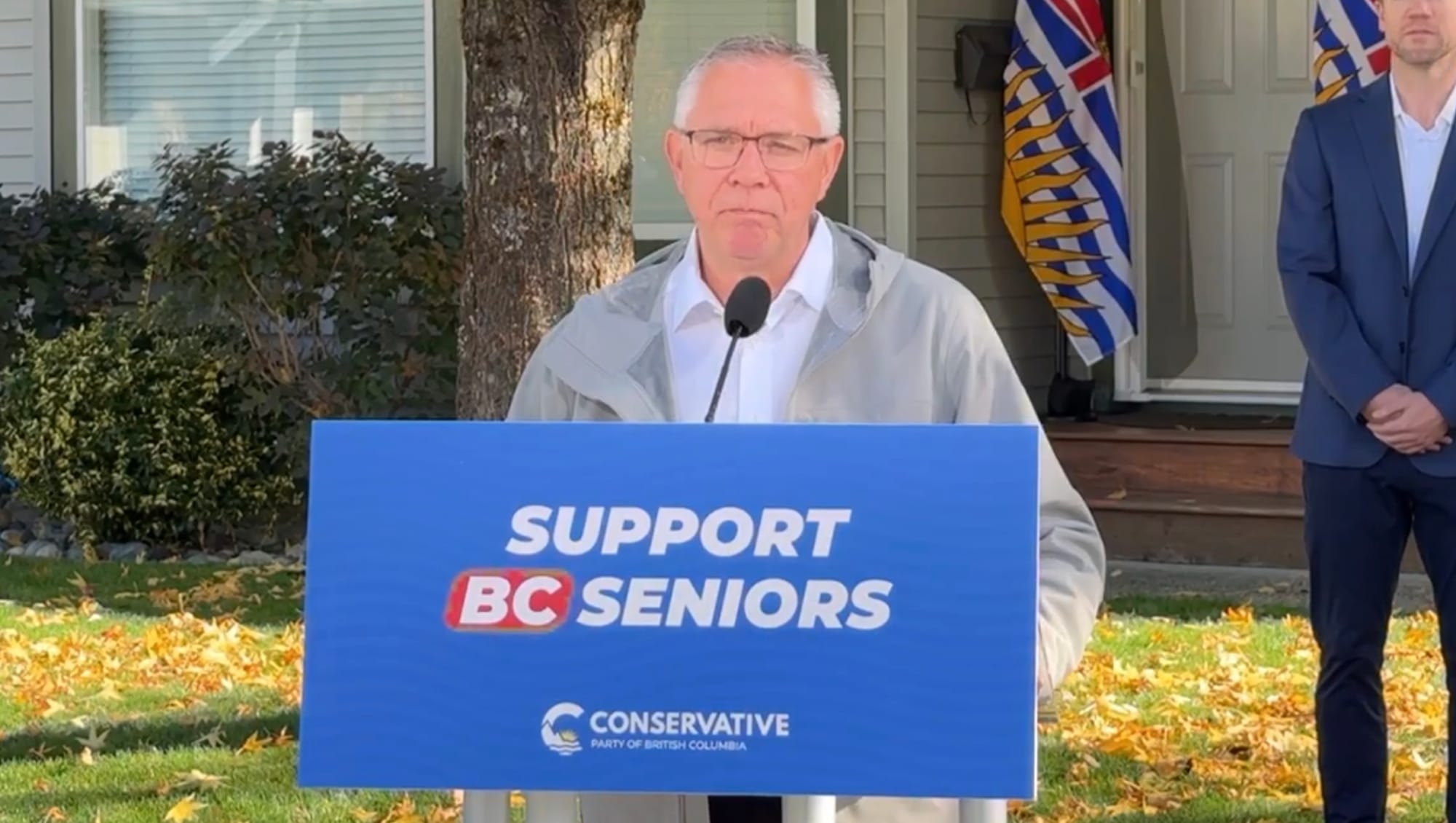
In short order, newly appointed interim leader for the Conservative Party of BC Lorne Doerkson has overseen a remarkable restoration of the party’s caucus. Within 48 hours of Findlay’s resignation, five former caucus members returned, followed by seven of the eight Conservative MLAs who had temporarily defected to CentreBC.
The reunification has extended beyond the sitting caucus, with former leadership rivals Caroline Elliott and Iain Black also rallying around Doerkson, as the party rapidly closes ranks around its new interim leader.
A party that had been disintegrating in real time only days prior was suddenly presenting itself once again as a stable, big-tent, centre-right coalition.
Doerkson himself may prove to be an unusually effective antidote to Eby’s central campaign argument. Unlike Kerry-Lynne Findlay, who celebrated her leadership victory with a dance that echoed the Trump dance, the “calm and collected” Doerkson is almost aggressively normie-core, offering few obvious aesthetic or substantive parallels to the US President. He has also adopted Eby’s own language of confrontation toward American aggression, describing Trump as a “bully” and positioning himself as willing to stand up to him.
If Doerkson can pair that persona with disciplined candidate vetting while keeping the party clear of both highfalutin culture-war obsessions and slopulist grievance politics, Eby may find himself fighting a very different campaign than the one he expected.
Eby can – and likely, will – still argue that the Conservatives represent “MAGA-style politics”. But Doerkson has already made the party a less tidy stand-in for MAGA than it was only days ago. Whether or not a whirlwind reunification and a strikingly normal interim leader can persuade voters that the BC Conservatives are a serious government-in-waiting is another question.
Maybe Eby still succeeds in making Donald Trump the defining issue of his snap election. But the cleaner the Conservatives make themselves look, the harder it becomes to make Trump the only thing voters see. And that is a major problem for the Premier.
If Trump does not define the ballot question, as Eby wants, then voters may decide that an election called two years early is an opportunity to deliver a very different message: a judgement on nearly four years of Eby’s premiership, or on the decision to call this election in the first place.
Yes, Premier David Eby decides when British Columbians vote.
He can present the election as urgent and necessary. He can propose the ballot question. He can portray his opponent as he wishes.
What he does not get to choose, however, is whether British Columbians play along.
Mo Amir is the host of “This is VANCOLOUR”, British Columbia’s bonafide culture and politics TV talk show, now in its sixth season on CHEK-TV, Thursdays at 9pm. He is also a prolific political commentator across several outlets.