
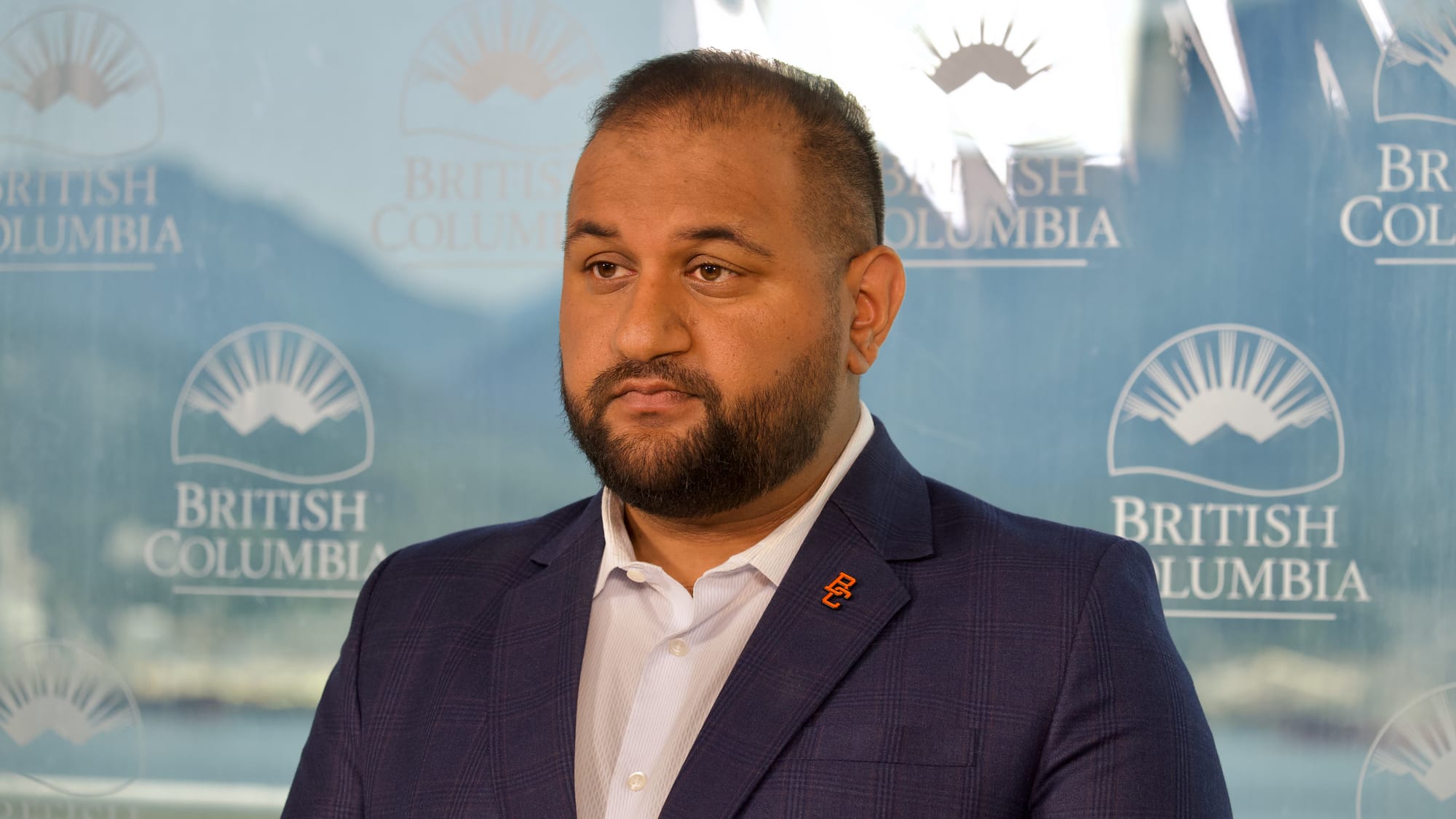

VANCOUVER — Custom cutters and processors in British Columbia will soon be able to access dedicated fibre under BC Timber Sales under a new expansion announced by Forests Minister Ravi Parmar.
He said the new measures are aimed at ensuring more value-added wood products are made in BC and exported globally, thus reducing the forestry sector's reliance on the United States.
Forests Minister @rparmar_BC announces custom cutters and processors will now be able to access BC Timber Sales logs:
— Sitka Media (@sitkamedia) July 13, 2026
“We’re gonna make more in BC by creating stability.” pic.twitter.com/S1KnK1HIqX
"Following Trump's aggressive trade policies against our forestry workers, the federal government the Forest Sector Transformation Task Force," Parmar said during a press conference in Vancouver on Monday. "The report recommendations point to strong supports for our value-added operators, so Canada can build high-quality products at home."
He noted that BC is uniquely positioned to "create world-class wood products to use at home and around the world," and that to unlock the sector's full potential, custom cutters and processors must have access to dedicated fibre.
The over 40 such companies in BC do not have their own saw mills, rather they partner with those that have the machines they need in order to create what their customers have ordered.
"There's no doubt in my mind that we still have challenging days ahead," Parmar continued. "Market conditions for lumber are low, the steep decline in our pulp sector is scary, and Trump tariffs alone are tough enough — but we are working as hard as we can to build a path forward for forestry."
Forests Minister @rparmar_BC says BC must “maximize the full value” of our wood by exporting more value-added products:
— Sitka Media (@sitkamedia) July 13, 2026
“BC — and I think it’s fair to say Canada — will no longer subsidize projects that simply provide commodity dimensional lumber to Americans.” pic.twitter.com/sHrSou2WcD
In response to a question from Sitka Media, Parmar explained that the value-added sector in BC has "seen considerable growth over the last few years," and that "investments" are being made across the province.
He noted that two of the largest continuous kilns in North America are under construction on Vancouver Island, and the largest mass timber facility in BC is being built in Castlegar.
"The message that I hear loud and clear from British Columbians is that we have to make more in BC," Parmar said, "and to make more in BC we need to address many of the challenges that exist in our forest sector today. We need to harvest more, but we need to ensure that we do so in a sustainable way — but in doing so we need to ensure that we maximize the full value."
He concluded by declaring that, "BC — and I think it's fair to say Canada — will no longer subsidize projects that simply provide commodity dimensional lumber to Americans."
When asked by Sitka Media what he felt has held BC's forestry sector back, Parmar said it's "complicated." He explained that what most people don't realize is that it's "full value chain."
"It's not just about our primary saw mills, it's not just about our secondary remand facilities," he said. "Our pulp sector plays a critical role; if you don't have a place to sell your residuals then you're in trouble. But all of that tied to duties and tariffs and international markets, who's building houses, who's not — it's a complicated industry."
Parmar added that the future success of the sector depends on "pivoting away from 'boom and bust' to stability and certainty."
Also in attendance was Tom Sundher, president of the Sundher Group and lifelong woodworker.
He argued that while BC's initial forestry success came from old growth timber, it was time to shift to mills that can process second-growth timber at a profit.
"We've got plenty of trees, and we've got plenty of second-growth timber to go," he said, "but we have to have investors come in here and start processing."