
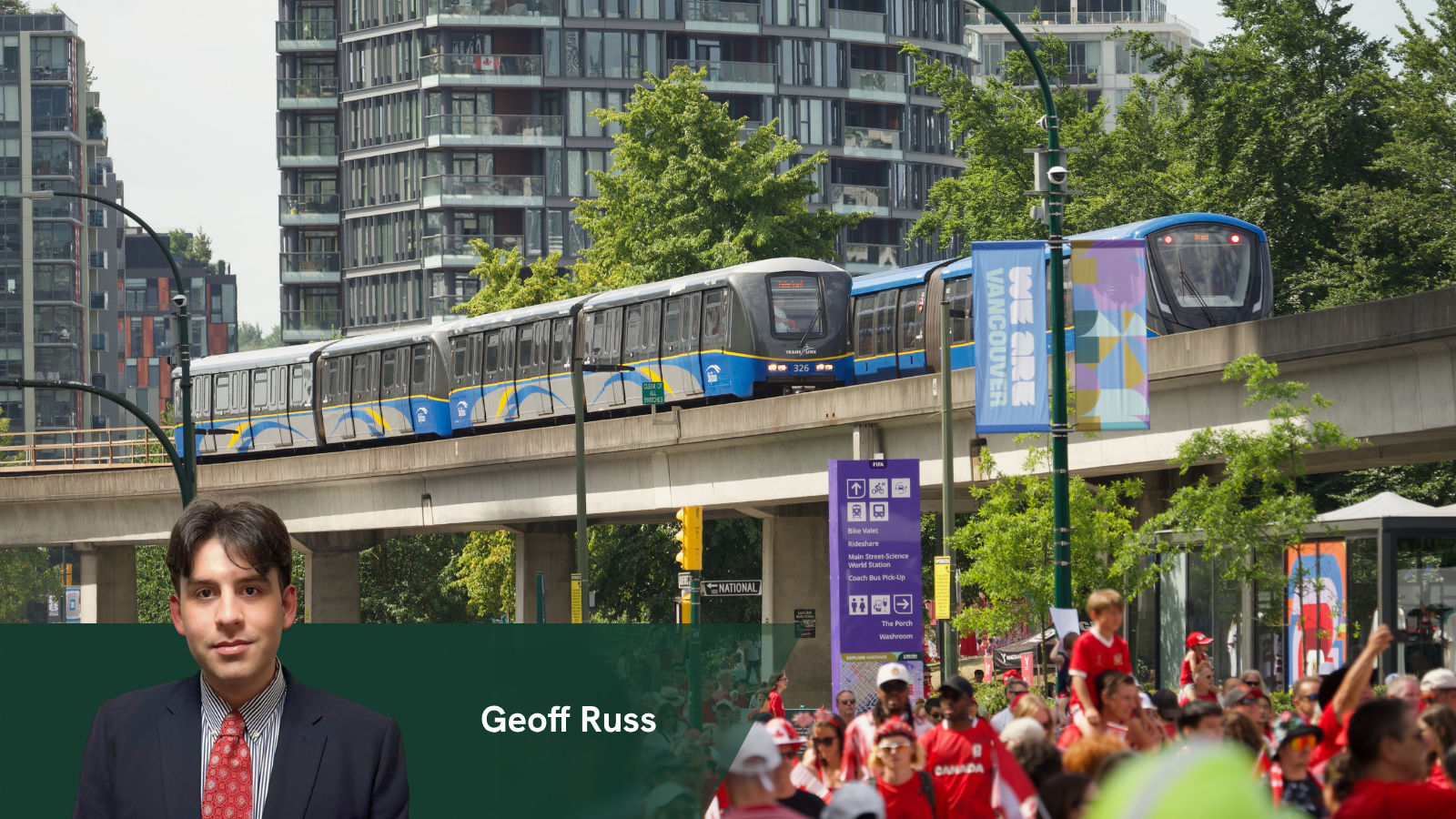

Granville Street’s performance during the World Cup has revived calls for a more pedestrianized city, and that is good.
Walkable cities with first-rate transit are rare and should be the ideal for any large urban area.
Five blocks of downtown Vancouver, stretching from Georgia Street to Davie Street, have proven to be a fantastic but sadly temporary addition to the city. Yes, Vancouver city council voted to extend the Granville Street Pedestrian Zone through Labour Day, but that means the best parts of autumn will see the cars return.
First, cars are wonderful tools, and I am certainly not anti-car. Not in the least: cars provide enhanced freedom of movement to the individual and are perfectly suited to the vast residential blocks that make up most of the city’s geography.
Nonetheless, our city centres should not be so jam-packed with them.
TransLink’s train network is still more about shuttling commuters in and out of downtown Vancouver and out to the suburbs than about connecting the whole core. It still takes far too long to get from the intersection of Granville and Georgia to English Bay.
The World Cup should be a catalyst for Vancouver’s gradual transformation into a more walkable, truly transit-oriented city.
Vancouver certainly has the bones to reach that goal, with well-defined corridors, compact neighbourhoods, and a population that is more or less comfortable with using the SkyTrain, if not the bus system. The official target is for two-thirds of all trips in the city to be made by active transportation and transit by 2030.
Unfortunately, aspiration is not a substitute for infrastructure.
Pedestrianized streets without strong transit, loading access, sanitation, programming, and business support are much less likely to succeed.
Metro Vancouver’s mass transit still relies heavily on buses. In 2025, there were more than 240 million bus boardings out of nearly 400 million boardings across the Metro Vancouver transit system, or about 61%.
As with cars, I have nothing against buses, but they are vulnerable to traffic and are squeezed and slowed by construction and bad left turns. In 2025, TransLink data put bus on-time performance at under 80%. By comparison, the SkyTrain’s Expo and Millennium lines had an on-time performance of nearly 95%.
The Broadway Subway project will be a major upgrade over the buses that currently ply one of Vancouver’s busiest thoroughfares. The extension of the Millennium Line by nearly six kilometres from VCC-Clark to Arbutus Street should ideally demonstrate the superiority of metro trains over buses, with six new underground stations helping to connect a large part of the city.
It would be great if that could become the template for Hastings Street, Commercial Drive, Davie Street, Main Street, and the West End. If all of those areas could be connected by a new rapid underground train, it would be the upgrade of the century.
London is a terrific example. With 11 lines, 402 kilometres, and 272 stations, the Underground is one of the world’s most robust and efficient ways to get people around a city. Unlike Vancouver, the London Underground properly connects major central districts in such a way that ordinary trips do not require careful timing, prayers, and soggy transfers in the rain.
Of course, Vancouver is nowhere near as large as London, but the London Underground is still a model worth emulating for a younger city with ambitions to become a transit haven.
Funding is clearly a major roadblock, but not an excuse. Shaking down Ottawa for money is not a bad option, because the goals of both the city of Vancouver and the federal Liberal government are aligned on reducing emissions and boosting transit. The Canada Public Transit Fund is explicitly for this purpose. Going big on ambition will hopefully help secure a bigger cheque.
Ottawa has shelled out more than $30 billion for a pipeline it was forced to buy — a problem of its own making, but more on that later — so it can surely find some money for TransLink.
Yes, this is not a fiscally conservative position, but cities have a responsibility to be selfish when it comes to procuring federal funds. If the money can be made available to help build up Vancouver’s transit system, the city should just take it and not ask questions.
Pedestrianization works best when it is not half-assed. Simply declaring a district to be car-free with no support is a recipe for disaster when businesses need loading zones and rely on car access for customers.
Car-free Granville Street has been a wonderfully fun and lively interlude during this World Cup. The weather will turn to horrid rain and grey skies after Halloween, as it always does, and reopening it to cars from November to March or April is a good compromise.
However, the large crowds of football-mad tourists will soon return home. Keeping Granville Street full is the best argument for keeping it pedestrianized. Doing that will require more than just vibes.
Geoff Russ is Editor-at-Large of Without Diminishment and contributor to the National Post.