
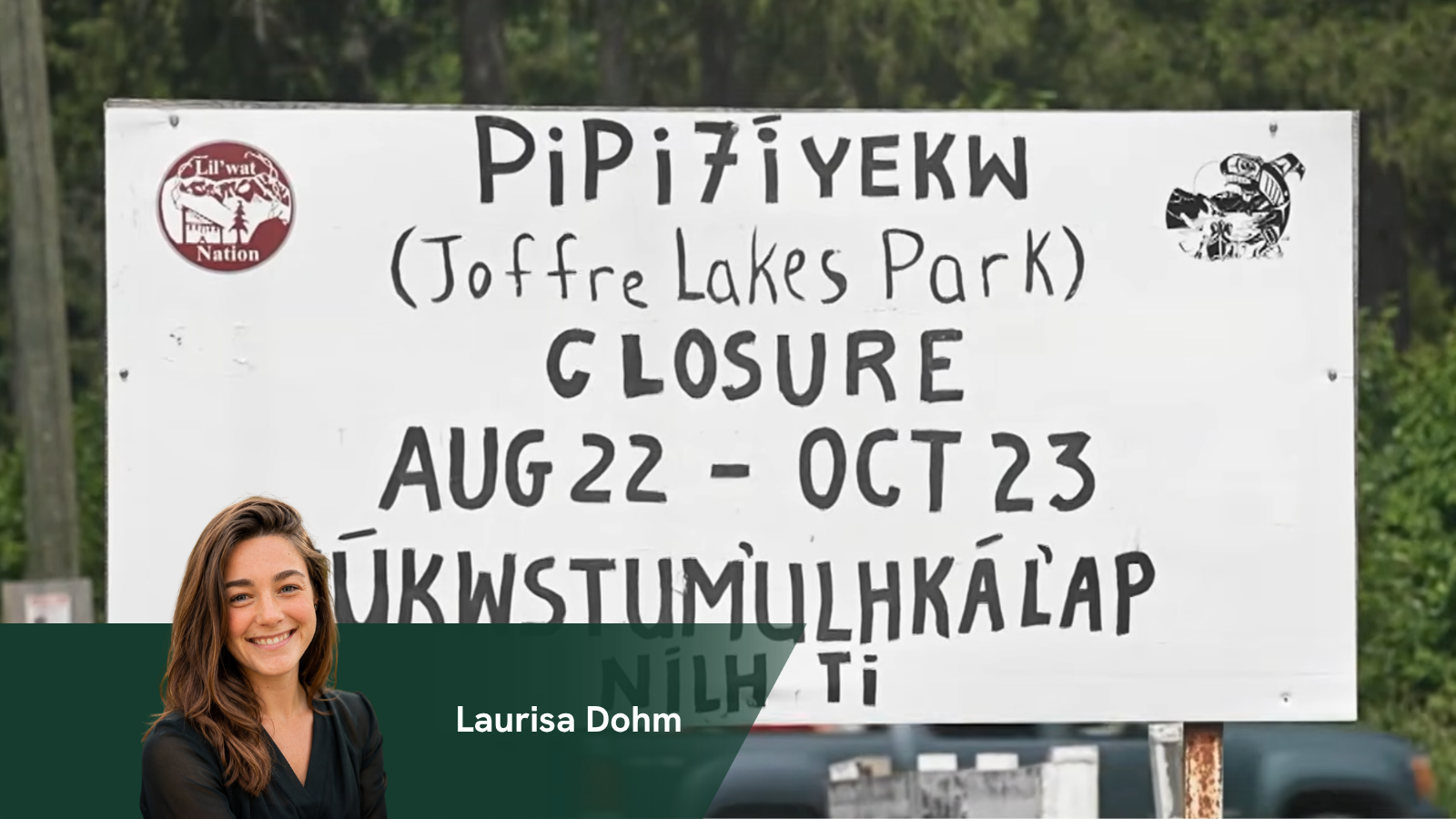

A few weeks ago, the Botanical Beach portion of Juan de Fuca Park and the entirety of Joffre Lakes Park were closed to the public.
BC’s Ministry of Environment and Parks justifies these provincial park closures as being necessary to provide members of local bands time and privacy to harvest marine resources and to reconnect with the land.
The closures have been criticized by those who argue that preferential and exclusive access to public land is unfair. Others support the policy on the grounds that it is part of reconciliation.
Whatever your view of these types of closures, it is altogether likely that they may become more common in the future.
This is because IPCAs – Indigenous Protected and Conserved Areas – have become a primary tool that advocacy groups and governments are now leveraging to protect 30% of Canada’s lands and waters by 2030 (30x30). But IPCAs are not the same as provincial or national parks.
Whereas both the Canada National Parks Act and BC's Park Act explicitly dedicate parks to the public for their benefit, education, and enjoyment, IPCAs are defined as “lands and waters where Indigenous governments have the primary role in protecting and conserving ecosystems through Indigenous laws, governance and knowledge systems”.
IPCAs have no consistent legal foundation in Canada.
Legal analysis outlines the “jurisdictional spectrum” of IPCAs, which ranges from exclusive Indigenous authority and governance to co-management under Crown legislation. Proponents explain that IPCAs are expressions of inherent Indigenous authority and "exist whether or not the Canadian state recognizes them."
The Pathway initiative by Canada Conservation, which is a partnership that includes federal and provincial departments responsible for conservation, clarify in their FAQ that IPCAs need not be primarily focused on conservation, stating that “the primary purpose of an IPCA could be sustainable fur harvesting” and it may still be counted towards Canada’s conservation targets, provided it effectively conserves biodiversity.
IPCAs can be understood as designed and intended with the primary goal of furthering Indigenous sovereignty and territorial control. Conservation may not necessarily be a primary driver, but rather a secondary benefit.
As of April 2024, there were approximately 14 IPCAs declared in BC. The IPCA Knowledge Basket states that they are generally open to the public, but that visitors must abide by codes of conduct set by the bands. Indeed, visitors to the Tla-o-qui-aht Tribal Parks near Tofino are asked to “take the ʔiisaak Pledge” which involves speaking truthfully and acting honourably, requiring that you “acknowledge Indigenous rights and title throughout the territory and conduct yourself as a guest”.
This means non-Indigenous public access to IPCAs is not guaranteed, and the gatekeeper is not a publicly elected government. We must therefore consider that closures to the public could become the norm once areas that are co-designed, co-designated, and co-managed by bands are implemented at scale.
Besides public access, another core issue with IPCAs is monitoring and enforcement.
In IPCAs, Indigenous guardians are the primary mechanism for compliance. BC Parks describe guardians as “an extension of First Nations self-determination, serving as their Nation's 'boots on the ground' and providing cultural expertise and stewardship, monitoring, public safety, education and knowledge exchange.” Notably missing from this description is enforcement.
This is because under Canadian law, guardians do not typically have the authority to issue tickets, levy fines, make arrests, or confiscate gear, meaning guardians cannot enforce regulations or punish non-compliance – with the exception of a pilot program in BC whereby 11 Indigenous guardians were given the same legal authorities as Park Rangers within parks and protected areas in their ancestral territories. The pilot expired in 2025 and its current status is unclear.
Monitoring without enforcement is not a sound approach to conservation; in the world of nature protection, protected areas which lack effective enforcement mechanisms are referred to as “paper parks”. This speaks to a governance vacuum where rules exist on paper, but have little meaning on the ground.
Extending a monitoring-only model across vast and remote protected areas staffed by guardians with no enforcement powers needlessly exposes Canada’s most precious natural areas to increased risk, compared to if they were being patrolled by Park Rangers or Wardens.
BC’s park closures generating controversy today are happening despite a statutory framework where the parks are designated for all members of the public to access and enjoy. What will public access to protected areas look like in 2030, if we reach our 30x30 goals through implementing IPCAs?
If governments’ approach to nature conservation is not well-designed or implemented moving forward, it is possible that we will succeed in decreasing both public access to nature and public trust in the mechanisms of nature conservation, all while actually failing to adequately protect nature.
Without clear answers on public access, governing authority, and enforcement, we risk building out a conservation system that is politically fragile and ineffective.
Laurisa Dohm is a BC-based consultant and policy advisor. She holds an M.Sc from Gothenburg University.